For centuries, the Arctic occupied a unique place in the strategic imagination of states. Its vast expanses of sea ice, extreme climate, and limited infrastructure rendered it largely inaccessible, serving more as a geographical barrier than as an arena for political rivalry. Today, however, the Arctic is undergoing a profound transformation. Environmental change, technological advancement, and shifting geopolitical priorities have elevated the region from the margins of international affairs to the forefront of strategic planning.
The gradual reduction of seasonal sea ice has increased the accessibility of northern maritime routes, shortened shipping distances between Europe and Asia, and renewed interest in the Arctic's considerable reserves of hydrocarbons, rare earth elements, fisheries, and critical minerals. These developments have attracted the attention of Arctic nations and non-Arctic powers alike.
The Arctic is no longer merely a scientific frontier. It has become an increasingly important geopolitical frontier.
Geography as Strategy
History repeatedly demonstrates that geography shapes international politics. Mountains, oceans, rivers, and maritime chokepoints influence trade, military planning, and national security. The Arctic represents one of the last great strategic frontiers where geography is being fundamentally redefined.
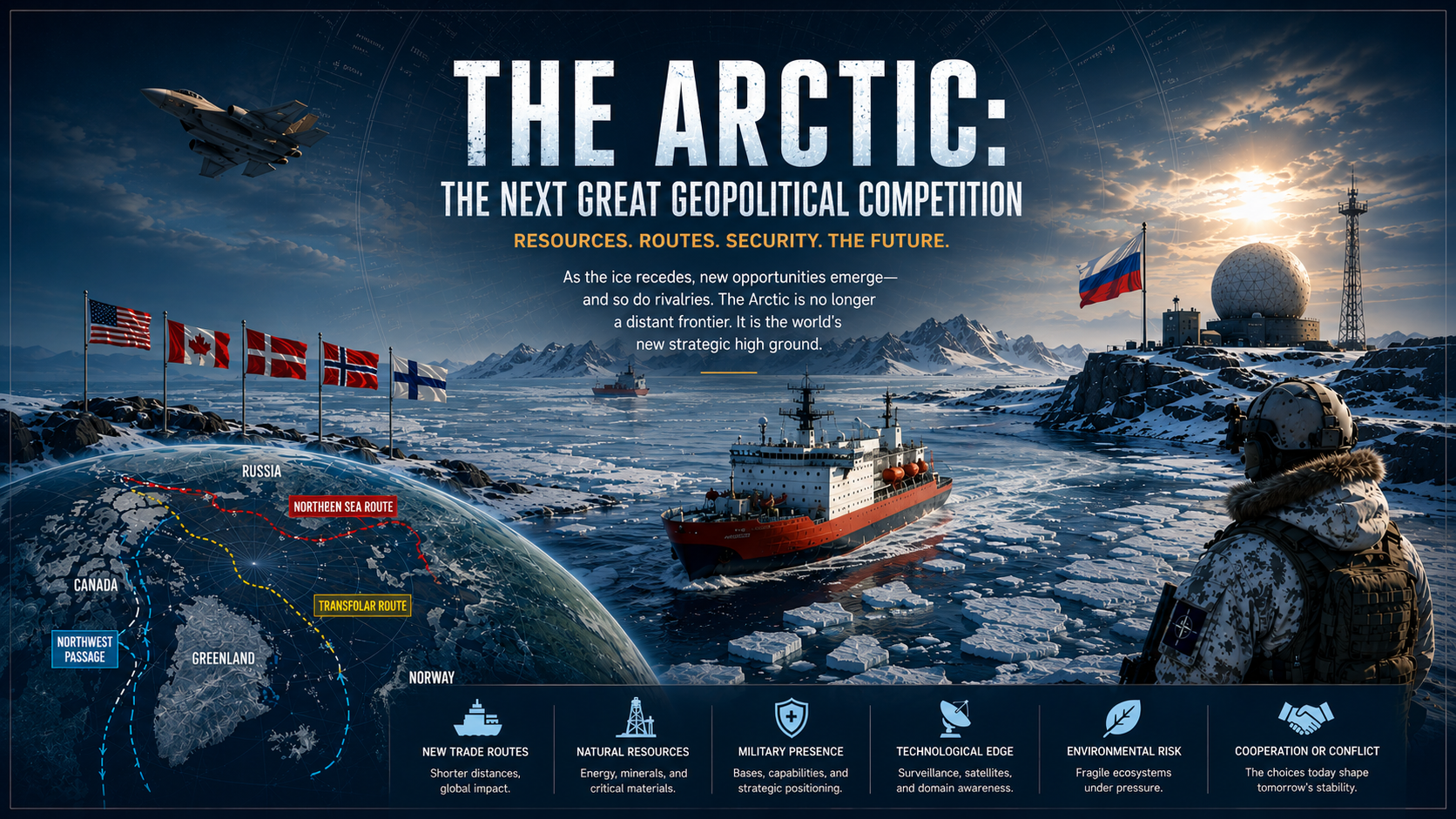
Three principal maritime corridors dominate contemporary discussion:
- The Northern Sea Route along Russia's Arctic coastline.
- The Northwest Passage through the Canadian Arctic Archipelago.
- A potential Transpolar Route crossing the central Arctic Ocean.
These routes could reduce travel times between Europe and Asia by thousands of nautical miles compared with traditional passages through the Suez Canal. While significant operational challenges remain, seasonal navigation is becoming increasingly feasible.
Shorter shipping routes offer clear commercial incentives, but they also introduce strategic considerations regarding freedom of navigation, search and rescue responsibilities, infrastructure development, and military presence.
Russia's Arctic Strategy
Among Arctic states, Russia has pursued the most comprehensive strategy for developing the region.
Approximately half of the Arctic coastline belongs to Russia, providing Moscow with significant geographic advantages. Over the past decade, Russia has invested heavily in Arctic infrastructure, including ports, airfields, radar installations, early-warning systems, and military bases. It also maintains the world's largest fleet of nuclear-powered icebreakers, enabling year-round operations in conditions that remain inaccessible to most other nations.
From Moscow's perspective, the Arctic serves several strategic purposes.
First, it protects the Northern Fleet, a central component of Russia's nuclear deterrent based on the Kola Peninsula.
Second, it provides access to vast energy reserves that remain essential to the Russian economy.
Third, it strengthens Russia's ability to project military power across the North Atlantic and the Arctic Ocean.
Russian policymakers consistently describe the Arctic as a region of national strategic importance rather than simply an area for commercial development.
NATO and the High North
Russia's growing military presence has prompted increased attention from NATO.
The accession of Finland and Sweden to the Alliance has significantly altered the Arctic security landscape. NATO now encompasses most Arctic member states, creating new opportunities for defense planning, intelligence sharing, and joint military exercises across northern Europe.
For NATO, the Arctic represents more than an environmental concern. It is increasingly viewed as an operational theater requiring enhanced surveillance, resilient communications, and credible deterrence.
Exercises involving Arctic warfare, cold-weather operations, and maritime interoperability have become more frequent as Allied forces adapt to evolving regional dynamics.
China's Arctic Ambitions
Although China possesses no Arctic coastline, Beijing has steadily expanded its engagement in the region.
In 2018, China described itself as a "Near-Arctic State," emphasizing its interest in scientific research, infrastructure investment, shipping, and resource development. Chinese policymakers have promoted the concept of a "Polar Silk Road" as part of the broader Belt and Road Initiative.
While China presents its Arctic activities as peaceful and commercially oriented, many governments remain attentive to their potential strategic implications. Investments in ports, telecommunications, satellite infrastructure, and scientific facilities may generate long-term geopolitical influence alongside economic benefits.
The Arctic increasingly illustrates how regions once considered peripheral can become central to global competition.
Resources Beneath the Ice
Beyond maritime routes, the Arctic is believed to contain significant deposits of oil, natural gas, rare earth elements, and other critical minerals.
As demand for strategic resources continues to increase, competition over exploration rights and infrastructure is likely to intensify. At the same time, environmental protection remains a central concern. Arctic ecosystems are exceptionally fragile, and industrial development carries substantial ecological risks.
Balancing economic opportunity with environmental stewardship will remain one of the defining policy challenges facing Arctic governments.
Governance and International Law
Unlike Antarctica, the Arctic is not governed by a comprehensive international treaty.
Instead, legal authority derives primarily from the United Nations Convention on the Law of the Sea (UNCLOS), which establishes rules regarding territorial seas, exclusive economic zones, and continental shelf claims.
Several Arctic states have submitted or are preparing submissions to extend their continental shelf rights under UNCLOS. These claims are reviewed through established international legal mechanisms, although overlapping interests continue to generate diplomatic complexity.
The Arctic Council has also played an important role in fostering scientific cooperation, environmental protection, and dialogue among Arctic nations. While the Council is not a security organization, it has contributed significantly to regional governance.
The Future of Arctic Competition
Future competition in the Arctic will extend well beyond traditional military considerations.
Satellite communications, undersea fiber-optic cables, autonomous vessels, artificial intelligence, critical infrastructure, cybersecurity, and climate adaptation are becoming integral components of Arctic strategy.
As commercial activity expands, governments will face difficult questions concerning maritime regulation, emergency response, indigenous rights, environmental protection, and international cooperation.
Whether the Arctic evolves into a region of sustained competition or responsible collaboration will depend largely upon the willingness of states to manage their differences through diplomacy while respecting international law.
Conclusion
The Arctic has entered a new strategic era.
Its importance no longer derives solely from geography but from the convergence of climate change, technological innovation, resource competition, and evolving great-power rivalry. Nations increasingly recognize that developments in the High North will influence global commerce, military planning, and international security for decades to come.
The region should not be viewed exclusively as a future battlefield, nor solely as an economic opportunity. Rather, it represents one of the clearest examples of how environmental transformation can reshape the geopolitical landscape.
Understanding the Arctic today is therefore essential to understanding the strategic challenges of the twenty-first century.
AFDES publishes independent research and strategic analysis on democracy, governance, public policy, international affairs, and civic institutions.