The competition between major powers is no longer defined only by aircraft carriers, nuclear weapons, trade routes, or military alliances. Increasingly, it is shaped by the invisible foundations of modern technology: rare earth minerals and critical materials.
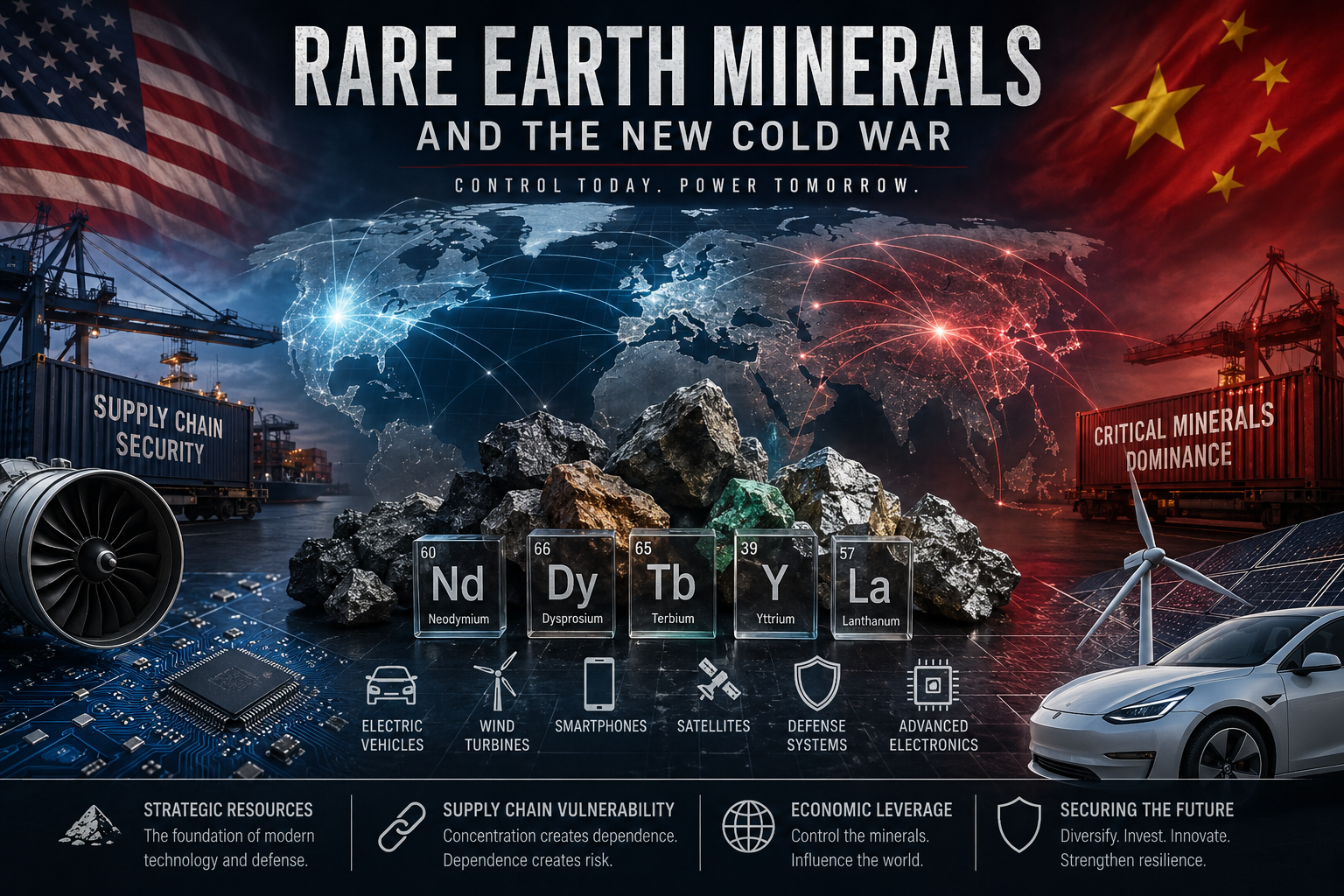
These resources are essential for advanced electronics, renewable energy systems, electric vehicles, smartphones, satellites, missile guidance systems, radar, wind turbines, batteries, and many defense technologies. Without secure access to these materials, even the most advanced economies can become vulnerable.
Rare earth minerals are not necessarily rare in geological terms. What makes them strategically important is the difficulty of mining, processing, refining, and integrating them into advanced industrial supply chains. The countries that control these stages gain leverage over the technologies that define economic and military power.
In this sense, rare earths have become a central front in the new era of strategic competition.
What Are Rare Earth Minerals?
Rare earth elements are a group of seventeen metallic elements used in advanced manufacturing. They include elements such as neodymium, dysprosium, terbium, yttrium, and lanthanum. These names are unfamiliar to most citizens, yet they are embedded in everyday life and national defense systems.
Neodymium is used in powerful magnets found in electric motors, wind turbines, hard drives, and precision weapons. Dysprosium helps magnets maintain performance under high temperatures. Yttrium is used in lasers, electronics, and medical technologies. Other rare earths support catalysts, batteries, display screens, optics, and aerospace systems.
Modern technology depends on them because they allow devices to become smaller, lighter, stronger, and more efficient.
The strategic problem is simple: demand for these materials is rising rapidly while supply chains remain concentrated and vulnerable.
China’s Dominant Position
China has spent decades building dominance across the rare earth supply chain. Its position is not based only on mining. More importantly, China controls significant processing and refining capacity.
This matters because extracting raw minerals is only the first step. Rare earths must be separated, refined, and manufactured into usable components such as magnets, batteries, and specialized materials. These processes require technical expertise, industrial infrastructure, environmental management, and long-term investment.
For many years, Western economies outsourced much of this capacity because it was cheaper, environmentally difficult, and commercially unattractive compared with other industries. China invested where others retreated.
The result is a strategic imbalance.
Even countries with rare earth deposits may still depend on Chinese processing facilities. This creates a vulnerability: a country may possess the mineral underground but still lack the industrial capacity to turn it into useful technology.
Critical Minerals as National Security Assets
During the age of globalization, many governments assumed that markets would efficiently provide the materials needed for industrial growth. Supply chains were judged primarily by cost, speed, and efficiency.
That assumption has weakened.
Pandemics, wars, trade disputes, sanctions, and geopolitical rivalry have demonstrated that supply chains can become instruments of power. A disruption in critical minerals could affect defense production, energy transition goals, telecommunications, transportation, and advanced manufacturing.
For national security planners, rare earth minerals are no longer ordinary commodities. They are strategic assets.
A country that cannot secure critical materials may struggle to produce advanced weapons, maintain modern infrastructure, build clean-energy systems, or compete in high-technology industries. Dependence on a geopolitical rival for these inputs can limit strategic autonomy during a crisis.
The Technology Connection
Rare earth competition is closely connected to the broader technological rivalry between the United States and China.
Artificial intelligence, semiconductors, electric vehicles, drones, satellites, quantum technologies, and advanced military systems all depend on complex supply chains. Critical minerals form part of that foundation.
The country that controls the materials, manufacturing base, and technical standards of emerging technologies can shape the future global economy.
This is why rare earth policy is now linked to industrial policy. Governments are no longer simply asking where products are cheapest. They are asking whether supply chains are secure, whether production can survive political pressure, and whether domestic industries can function during conflict or sanctions.
The new question is not only economic.
It is strategic: who controls the inputs of the future?
Environmental and Political Challenges
Developing rare earth supply chains outside China is not easy.
Mining and refining rare earths can produce environmental damage if poorly managed. Communities may oppose new mines because of pollution concerns, land use, water risks, or lack of trust in government oversight. Permitting can be slow, expensive, and politically controversial.
There is also the challenge of scale. Building a mine is not enough. Countries need processing facilities, skilled workers, transportation networks, environmental safeguards, financing, customers, and long-term government support.
This creates a difficult policy balance.
Democratic countries must secure strategic resources while respecting environmental standards, local communities, labor rights, and transparency. If they fail to build supply chains responsibly, they may simply replace one vulnerability with another.
The Role of Allies
No single democratic country can solve the rare earth challenge alone.
A realistic strategy requires cooperation among allies and partners. The United States, Canada, Australia, Japan, South Korea, and European countries all have roles to play. Some possess mineral deposits. Others have advanced manufacturing capacity, financing tools, or technology companies that depend on secure supplies.
Partnerships can help diversify supply chains, share investment risk, establish environmental standards, and reduce dependence on a single country.
This is not about isolation from global trade. It is about resilience.
A resilient supply chain does not require producing everything domestically. It requires ensuring that no adversary can easily disrupt the materials necessary for national security and economic stability.
Strategic Leverage and Economic Coercion
Rare earth minerals can become tools of economic coercion.
If one country dominates supply and processing, it can restrict exports, raise costs, delay shipments, or pressure foreign companies and governments. Even the threat of disruption can influence decision-making.
This gives rare earths a geopolitical role similar to oil in the twentieth century. Oil shaped alliances, wars, industrial growth, and foreign policy. Critical minerals may play a similar role in the twenty-first century, especially as economies move toward electrification, automation, and digital infrastructure.
The lesson is clear: strategic dependence creates political vulnerability.
Policy Priorities for the Next Decade
Governments seeking to reduce vulnerability should focus on several priorities.
First, they must identify which minerals are essential for defense, energy, transportation, and technology. Not all materials carry the same strategic importance.
Second, they must invest in domestic and allied processing capacity. Mining without refining does not solve the problem.
Third, they must support recycling and substitution technologies. Recovering rare earths from old electronics, batteries, and industrial waste could reduce pressure on primary mining.
Fourth, they must create predictable rules for investment. Companies will not build expensive facilities unless they believe governments are committed for the long term.
Finally, democratic countries should build transparent partnerships with resource-rich nations. Critical mineral diplomacy will become a major part of foreign policy.
Conclusion
Rare earth minerals are now part of the architecture of global power.
They connect technology, defense, energy, trade, industrial policy, and national security. The countries that control these materials and the industries built upon them will shape the future of economic and military competition.
The new Cold War is not only about ideology or territory. It is also about supply chains, minerals, factories, laboratories, and the technological systems that determine national power.
For the United States and its allies, the strategic lesson is urgent: dependence on a geopolitical rival for critical materials is not merely an economic inconvenience. It is a national security risk.
Rare earths may be hidden beneath the ground, but their importance is now visible at the highest levels of international politics. Understanding them is essential to understanding the future of great-power competition.
AFDES publishes independent research and strategic analysis on democracy, governance, public policy, international affairs, and civic institutions.