Taiwan: The World's Most Dangerous Flashpoint
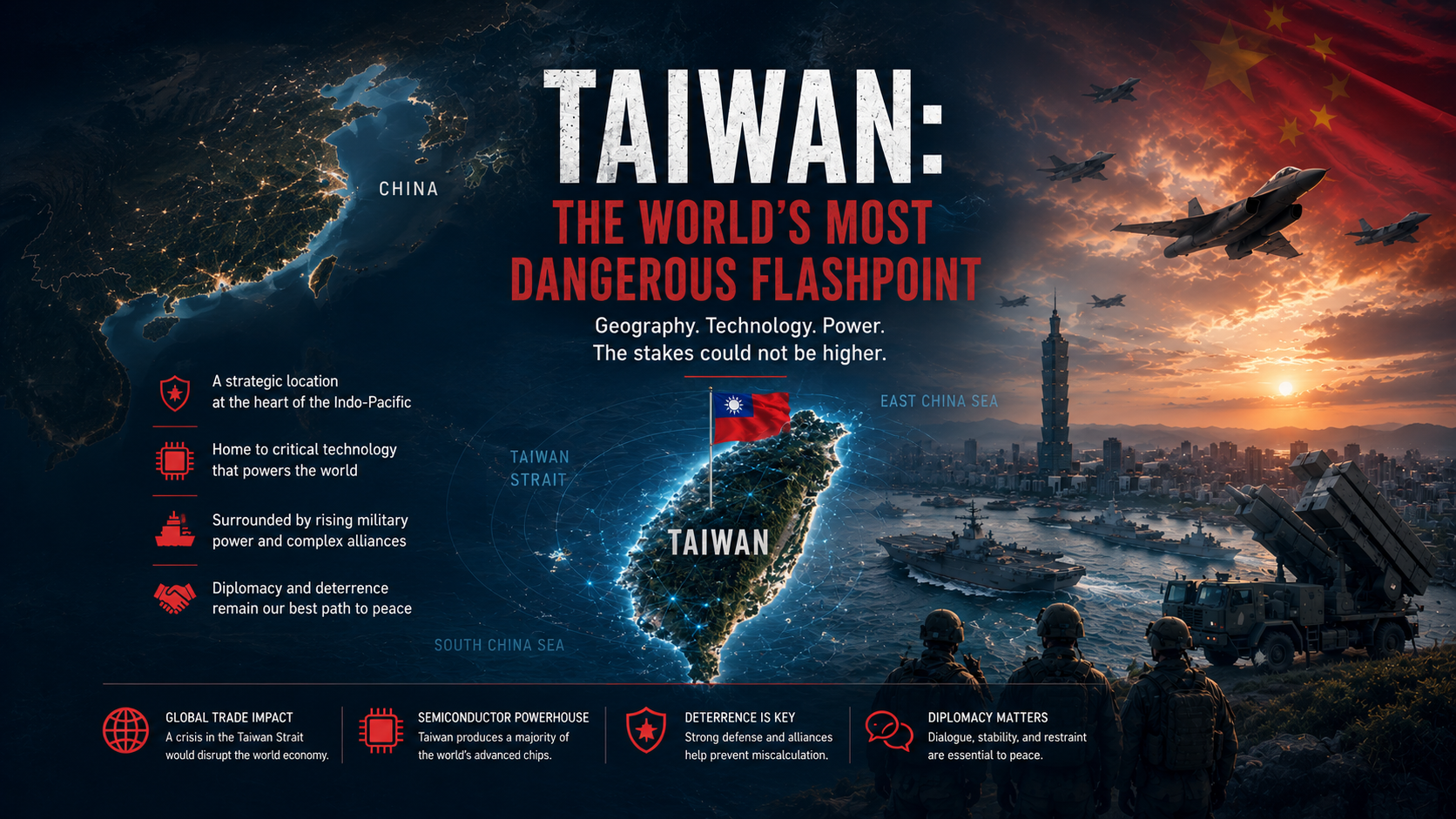
Few places on Earth carry greater strategic significance than Taiwan. Located less than 200 kilometers from mainland China, the island sits at the crossroads of military strategy, international commerce, technological innovation, and competing visions of regional order. Although Taiwan occupies a relatively small geographic area, developments surrounding the island possess the potential to influence global markets, reshape alliance structures, and affect the broader balance of power in the Indo-Pacific.
For decades, Taiwan has remained one of the most sensitive issues in relations between the People's Republic of China and the United States. Beijing regards Taiwan as an inseparable part of China and has consistently stated that reunification remains a national objective. Taiwan, meanwhile, has developed into a vibrant democratic society with its own elected government, military, judicial institutions, and economy. While the island does not enjoy widespread formal diplomatic recognition as an independent state, it functions in practice with many of the characteristics of one.
The result is a geopolitical environment marked by strategic ambiguity, military deterrence, economic interdependence, and increasing competition between the world's two largest powers.
Taiwan's Strategic Geography
Geography has always influenced the distribution of power. Taiwan forms part of the so-called First Island Chain, a series of islands stretching from Japan through the Ryukyu Islands, Taiwan, the Philippines, and into Southeast Asia. This chain plays an important role in maritime strategy because it separates China's coastal waters from the broader Pacific Ocean.
From Beijing's perspective, Taiwan represents both a historical issue and a strategic challenge. Control of the island would expand China's access to the Western Pacific, reduce geographic constraints on naval operations, and strengthen its ability to project power throughout the region.
For the United States and many regional partners, Taiwan contributes to maintaining a balance of power that supports freedom of navigation, regional stability, and open commercial sea lanes.
Its location therefore gives Taiwan significance extending well beyond its own borders.
The Legacy of the Chinese Civil War
Understanding Taiwan requires an appreciation of history.
Following the Chinese Civil War, the government of the Republic of China relocated to Taiwan in 1949 after the Communist Party established the People's Republic of China on the mainland. Since then, both governments have maintained differing interpretations regarding sovereignty over China.
Over the decades, Taiwan transformed itself politically and economically. It evolved from authoritarian rule into one of Asia's most dynamic democracies, holding competitive elections, protecting civil liberties, and establishing an advanced market economy.
This political evolution has strengthened a distinct Taiwanese identity among many residents while further complicating the question of future political status.
Strategic Ambiguity
One of the defining features of Taiwan policy has been the doctrine commonly described as strategic ambiguity.
For decades, the United States has acknowledged Beijing's position that there is one China while simultaneously maintaining unofficial relations with Taiwan through the Taiwan Relations Act. Washington provides defensive military equipment to Taiwan and emphasizes that any resolution of cross-strait differences should occur peacefully.
Importantly, the United States has traditionally avoided explicitly stating whether it would intervene militarily in the event of a conflict. This ambiguity seeks to discourage both a unilateral declaration of independence by Taiwan and the use of force by Beijing.
Whether this approach remains sufficient under changing strategic conditions continues to be debated by policymakers and scholars.
Taiwan's Technological Importance
Taiwan's strategic significance extends beyond military considerations.
The island occupies a central position in the global semiconductor industry. Taiwanese firms manufacture a substantial share of the world's advanced semiconductor chips, which are essential for smartphones, medical equipment, automobiles, artificial intelligence, aerospace systems, telecommunications, and defense technologies.
Disruptions affecting Taiwan's semiconductor production would likely have significant consequences for global supply chains and multiple sectors of the international economy.
For this reason, Taiwan is frequently described not only as a geopolitical flashpoint but also as a cornerstone of the digital economy.
Military Modernization
The People's Liberation Army (PLA) has undergone extensive modernization during the past two decades. Investments in naval forces, missile systems, cyber capabilities, space assets, and air power have substantially expanded China's military capabilities in the Indo-Pacific.
Taiwan has responded by emphasizing asymmetric defense concepts designed to complicate any potential military operation. Rather than matching China's numerical strength directly, Taiwanese defense planners increasingly focus on mobility, survivability, precision weapons, coastal defense, unmanned systems, and resilient command structures.
Meanwhile, the United States and regional partners continue to strengthen cooperation through joint exercises, intelligence sharing, and enhanced interoperability.
These developments illustrate a broader trend toward intensified strategic competition rather than inevitable conflict.
International Implications
A crisis involving Taiwan would extend far beyond East Asia.
The Taiwan Strait serves as one of the world's most important maritime corridors, supporting international trade connecting Northeast Asia with global markets. Regional instability could disrupt shipping, financial markets, insurance costs, manufacturing, and energy supplies.
Moreover, allies throughout the Indo-Pacific—including Japan, Australia, South Korea, and the Philippines—would face complex security and diplomatic decisions.
The implications would therefore be global rather than regional.
Deterrence and Diplomacy
Despite increasing military activity, deterrence remains the central objective of all major actors.
Military preparedness seeks to discourage conflict rather than provoke it. Diplomatic communication, confidence-building measures, crisis management mechanisms, and economic engagement continue to play important roles in reducing the risk of miscalculation.
History demonstrates that great-power competition does not inevitably produce war. Effective diplomacy, credible deterrence, and responsible political leadership remain essential components of long-term stability.
Conclusion
Taiwan represents far more than a territorial dispute.
It stands at the intersection of strategic geography, democratic governance, advanced technology, maritime commerce, and international security. Its future will influence not only cross-strait relations but also the broader evolution of the Indo-Pacific and the international system.
For policymakers, understanding Taiwan requires balancing historical context, legal complexity, military strategy, economic interdependence, and the importance of preserving peace. In a century increasingly shaped by great-power competition, few regions deserve closer attention than the Taiwan Strait.
AFDES publishes independent research and strategic analysis on democracy, governance, public policy, international affairs, and civic institutions.