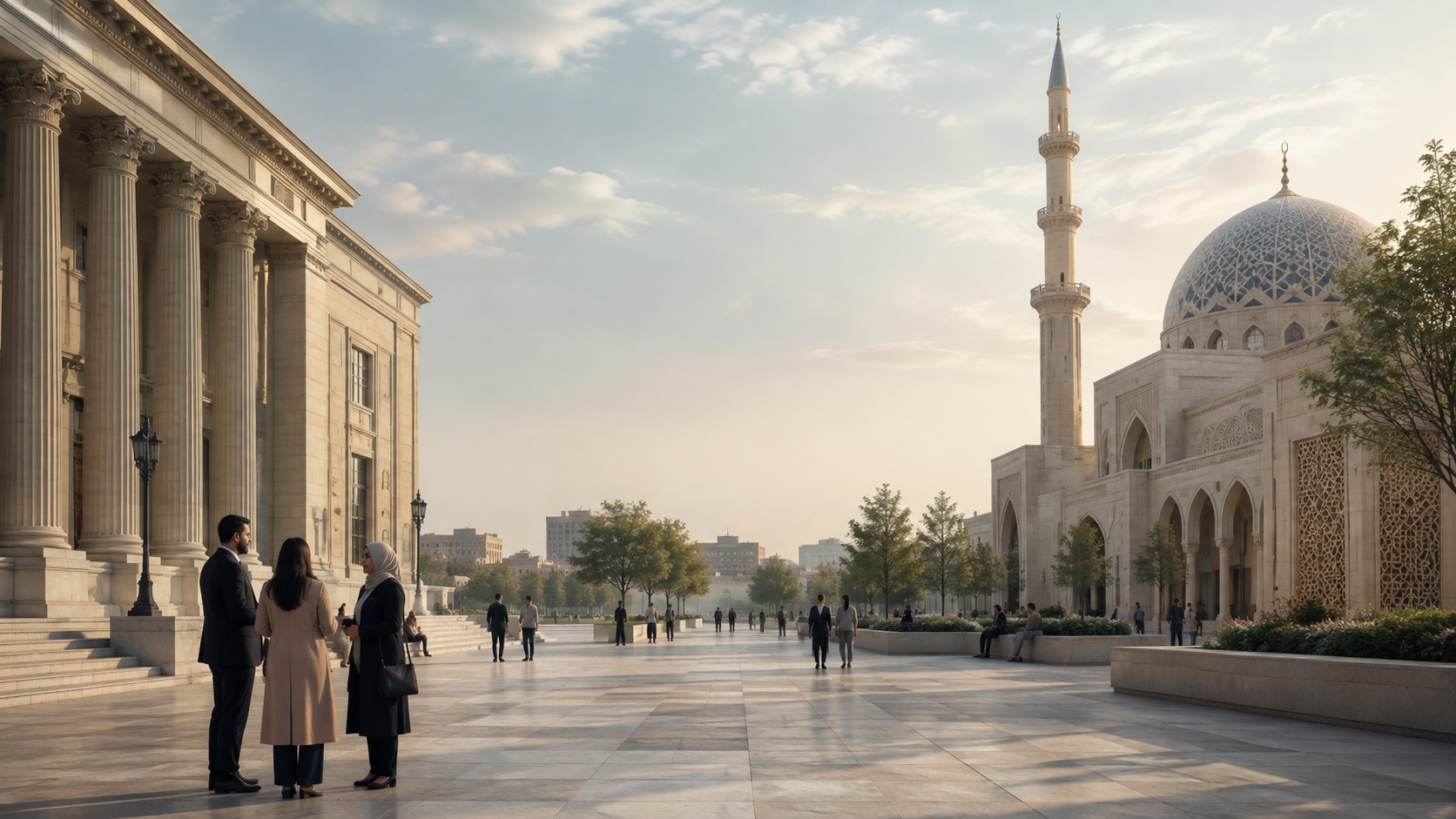
In 2012, while attending lectures by Algerian sociologist and political scientist Lahouari Addi in Lyon, France, I had the opportunity to discuss with him a question that had preoccupied political thinkers for generations: can Islam, not simply as a private faith but as a political and social order, coexist fully with liberal democracy?
It was during those conversations that Addi directed my attention to the work of Elie Kedourie. I remember the discussion because the question was never as simple as whether Muslims could live democratically. Clearly… they can, and millions do. The more difficult question concerned the relationship between political culture and democratic institutions: what happens when religious authority, political authority, civil law, personal identity, and collective belonging occupy the same space?
More than a decade later, that discussion feels considerably less theoretical.
Europe today is confronting difficult questions about migration, integration, religious freedom, national identity, secular government, and the limits of cultural accommodation. Similar debates exist in the United States, Canada, Australia, and elsewhere across the democratic West. Governments simultaneously face the obligation to protect religious minorities and the responsibility to preserve constitutional principles that cannot become negotiable every time they encounter a competing cultural norm.
The debate is therefore not fundamentally about Islam versus Christianity, Muslims versus Europeans, or immigrants versus native populations. It is about something deeper: whether a democratic society can preserve pluralism without surrendering the civic principles that make pluralism possible in the first place.
Tocqueville and the Political Character of Religion
Alexis de Tocqueville is remembered primarily for Democracy in America, his extraordinary examination of American democratic society. Yet Tocqueville also spent considerable time studying Algeria and Islam. He read the Quran and attempted to understand Muslim institutions while France was establishing colonial rule in Algeria.
His conclusions were often severe, and they must also be understood within the colonial assumptions of nineteenth-century Europe. Tocqueville himself supported aspects of French colonial expansion that deserve serious criticism today. His observations about Islam cannot simply be detached from that historical context and treated as neutral anthropology.
But dismissing them entirely would be equally simplistic.
What interested Tocqueville was the relationship between religious authority and political authority. He believed that one important characteristic of Western political development was the gradual differentiation of the spiritual sphere from the temporal one. Christianity had certainly participated in political power, sometimes brutally, throughout European history. Nevertheless, Christianity contained an institutional distinction between religious and political authority that eventually contributed to the possibility of a secular political order.
Tocqueville believed that classical Islamic civilization had developed differently. In his analysis, religious doctrine, civil law, political authority, and social regulation were intertwined to a much greater extent. His concern was not merely theological. It was institutional.
For Tocqueville, the danger appeared when political rules acquired divine authority. A law created by citizens can be debated, amended, challenged in court, repealed, or rejected at the ballot box. A command believed to originate directly from God occupies an entirely different intellectual category. Compromise becomes more difficult because changing the law can appear equivalent to challenging the divine itself.
His criticism of Islam therefore formed part of a much broader concern about democratic society: political freedom requires institutions and social habits capable of tolerating disagreement.
This is an important distinction. Tocqueville was not opposed to religion in democratic life. Quite the contrary. His observations of the United States convinced him that religious belief could provide moral foundations supporting a free society. His concern was the concentration of religious and political authority. His writings on Islam emphasized precisely this fusion of spheres.
That distinction remains remarkably relevant.
Kedourie and the Problem of Political Culture
More than a century later, Elie Kedourie approached the problem from the perspective of a historian of the modern Middle East.
Born in Baghdad and later becoming one of Britain's prominent scholars of Middle Eastern history, Kedourie challenged the assumption that democratic institutions could simply be transplanted from one society into another.
His 1992 study, Democracy and Arab Political Culture, appeared during an extraordinary historical moment. The Soviet Union had collapsed. Communist governments had fallen across Eastern Europe. Democracy appeared to be spreading almost inevitably across the world.
Yet the Middle East remained remarkably resistant to this democratic wave.
Kedourie asked why.
His explanation emphasized history and political culture. Parliamentary institutions, constitutions, elections, and political parties were not sufficient by themselves. Democracy depended upon deeper habits: acceptance of legitimate opposition, limitations on executive authority, peaceful transfers of power, individual rights, institutional independence, and the willingness to accept an electoral defeat without considering the victor an illegitimate enemy.
The Washington Institute's introduction to Kedourie's work described his approach explicitly as an examination of Islamic political traditions, the introduction of Western political ideas during the nineteenth century, and the extent to which those ideas succeeded or failed to establish durable roots in Middle Eastern societies.
This is where Kedourie's argument becomes uncomfortable but important.
Democracy is not simply an election.
A movement can participate in an election without believing in liberal democracy. A political organization can use democratic institutions instrumentally—accepting elections while they provide a route to power and rejecting democratic restraints once power has been obtained.
The Algerian crisis of the early 1990s demonstrated precisely the terror hidden within this dilemma.
Following political reforms, Algeria introduced a multiparty system. The Islamic Salvation Front emerged as an enormously powerful political force, winning local elections in 1990 and leading the first round of parliamentary elections in December 1991. The military intervened, canceled the electoral process, and Algeria subsequently descended into a devastating civil conflict.
The question that followed was almost impossible to answer.
Should democracy permit an anti-democratic movement to use democratic elections to dismantle democracy?
And conversely, can a government claim to be defending democracy by canceling an election?
These contradictions were at the center of the political environment Addi was analyzing.
Addi's Crucial Distinction
Lahouari Addi's position is particularly valuable because it avoids the easiest answer.
He does not argue that Islam itself mechanically produces authoritarianism.
In his analysis of Algeria, Addi explicitly distinguishes religion from the political interpretation of religion. As he argues, Islam as a religion does not intrinsically choose democracy or dictatorship; what matters is how religious belief is interpreted and how it interacts with political conflict and institutions.
That distinction profoundly changes the debate.
The problem is not that a citizen believes in Islam.
The problem arises when any religious or ideological movement claims that its authority stands above the constitutional order and that political legitimacy ultimately belongs exclusively to those who correctly interpret a sacred truth.
Addi made the point with remarkable clarity: religion can coexist with democracy when religion does not consider itself the exclusive legitimate holder of political power. Democracy does not require atheism. In his formulation, democracy is essentially “areligious”—it neither demands religious belief nor requires its absence.
That idea stayed with me after Lyon.
It provides a bridge between Tocqueville's institutional concerns and the modern democratic dilemma.
A Muslim citizen does not need to abandon Islam to participate fully in a democratic society any more than a Christian must abandon Christianity, a Jew Judaism, or a Hindu Hinduism.
But citizenship in a liberal democracy requires something else: acknowledgment that no religious community possesses a superior political citizenship.
The Constitution belongs equally to the believer and the atheist.
From Political Theory to Europe's Cultural Debate
This is where a discussion that once belonged primarily to political philosophy enters the streets of contemporary Europe.
European societies have undergone enormous demographic and cultural change through decades of migration. At the same time, Europe remains constitutionally committed to freedom of conscience and religion. In April 2026, the Parliamentary Assembly of the Council of Europe reaffirmed that freedom of religion or belief—including the freedom not to believe—is a fundamental element of democratic society and called for stronger protection against religious discrimination.
That principle is indispensable.
Muslims cannot be treated as collectively responsible for terrorism, extremism, misogyny, antisemitism, or authoritarian ideologies committed by individuals claiming to act in the name of Islam. Collective suspicion is incompatible with liberal democracy, and European institutions have correctly warned against portraying religious affiliation itself as proof that a minority is incompatible with European society.
But liberalism becomes incoherent if tolerance operates in only one direction.
A democratic society has a right to expect those who join it—regardless of religion or country of origin—to respect its constitutional order.
Freedom of religion does not mean freedom to impose religious rules upon others.
Cultural sensitivity cannot require accepting forced marriage, political violence, intimidation of apostates, religious censorship, antisemitism, persecution of homosexuals, inequality before the law, or the subordination of women.
Nor should criticism of a religion be confused automatically with hatred toward its followers.
The distinction is essential.
A Muslim citizen must be protected from discrimination as vigorously as any other citizen. Islam, however, like Christianity, Judaism, capitalism, socialism, nationalism, secularism, or any other system of ideas, must remain open to criticism.
People have rights.
Ideas do not have a right not to be questioned.
The Mistake of Cultural Relativism
For many years, Western governments have struggled to find the correct vocabulary for this issue.
One response has been assimilation: newcomers should essentially become culturally indistinguishable from the majority.
That approach is neither realistic nor necessary.
The opposite response has been multicultural relativism: different communities should be permitted to maintain fundamentally different social norms, with government intervening as little as possible.
That approach creates a different danger.
A liberal democracy cannot maintain several contradictory definitions of citizenship simultaneously.
There can be enormous diversity in language, food, clothing, religion, family tradition, art, customs, and private morality. That diversity enriches societies.
But constitutional principles cannot be partitioned by community.
A woman cannot possess fewer rights because the traditions of her community say she should.
A writer cannot possess less freedom of expression because another citizen considers his work blasphemous.
A former Muslim cannot possess less freedom of conscience than a practicing Muslim.
A Christian, Jew, atheist, or Muslim cannot be placed under a different standard of citizenship because of what another religious community believes about them.
This is precisely where cultural accommodation reaches its legitimate limit.
The democratic state protects difference until the exercise of that difference begins to deny another person equal citizenship.
That is not cultural imperialism.
It is constitutional government.
The Western Contradiction
The West must also recognize its own contradictions.
It is intellectually dishonest to discuss Islamic political authoritarianism while pretending that Western societies have perfectly separated religion, nationalism, and political power.
They have not.
Christian nationalism can threaten liberal institutions. Ethnic nationalism can threaten minorities. Populist movements can undermine judicial independence. Governments can manipulate fear of immigrants for political advantage. Democratic majorities themselves can become intolerant.
Tocqueville understood this danger extraordinarily well. Some of his most famous warnings were directed not toward Islam but toward democracy itself—particularly the possibility that majority opinion could become oppressive and that citizens might surrender liberty in exchange for security or conformity.
The lesson therefore cannot be that Western civilization represents democracy while Islam represents authoritarianism.
History immediately disproves such a simplistic claim.
The stronger conclusion is that every political culture contains forces capable of challenging liberal democracy.
Islamism is one of them.
Religious nationalism is another.
Racial nationalism is another.
Revolutionary ideological movements can pose the same threat.
The democratic question is always the same: does a movement accept that its opponents possess exactly the same political rights that it claims for itself?
If the answer is no, the problem is not diversity.
The problem is anti-democratic politics.
Immigration Without Civic Integration
This distinction also exposes one of the most serious mistakes in the modern immigration debate.
Western countries often discuss immigration almost entirely as an administrative or economic question: how many people can enter, how many workers are needed, how asylum applications should be processed, or where newcomers should be housed.
Europe's migration system itself has undergone substantial reform, with the EU Pact on Migration and Asylum entering into application on June 12, 2026, establishing new common procedures for asylum, screening, responsibility, returns, and solidarity among member states.
But immigration is also a civic process.
A country does not simply admit labor.
It admits future neighbors, voters, parents, teachers, business owners, public officials, activists, and citizens.
Integration therefore cannot mean merely learning enough of the language to find employment.
It requires understanding the constitutional culture of the society one is entering.
That obligation must also be reciprocal. Host societies cannot demand civic loyalty while permanently treating immigrants and their children as outsiders. If an individual accepts the constitutional principles of the country, obeys its laws, participates peacefully in its institutions, and considers that country home, then democratic citizenship must eventually mean exactly what it says.
There cannot be permanent probationary citizenship based upon ancestry.
The social contract has two sides.
The newcomer must accept the constitutional order.
The constitutional order must accept the newcomer.
What I Remember From Lyon
Looking back at my conversations with Lahouari Addi in Lyon in 2012, I understand more clearly why Kedourie entered the discussion.
The interesting question was never whether Islam could be reduced to a simple verdict of “compatible” or “incompatible” with democracy.
Civilizations do not vote.
Individuals do.
Institutions govern.
Political movements organize.
Cultures evolve.
Religions are interpreted.
That is why Addi's contribution remains so important. He took seriously the existence of what he described in his scholarship as an Islamist utopia capable of obstructing political modernity, while simultaneously rejecting the deterministic conclusion that Muslim societies are condemned to authoritarianism. His analysis of Algeria showed how authoritarian governments and Islamist movements could reinforce one another: repression prevented democratic development, while fear of political Islam was then used to justify further repression.
That vicious circle remains one of the most important lessons of the debate.
You cannot create liberalism by suppressing liberty.
But neither can democracy survive if it refuses to defend the conditions that make democratic life possible.
Democracy Must Be Confident Enough to Defend Itself
The debate that Tocqueville began in the nineteenth century, that Kedourie revisited at the end of the twentieth, and that Addi examined through the tragedy of Algeria is therefore not an antiquarian discussion.
It has moved into the center of twenty-first-century politics.
The cultural tensions now visible throughout much of the Western world will not be solved by declaring Islam incompatible with democracy.
Nor will they be solved by pretending that every cultural practice is equally compatible with a liberal constitutional order.
Both answers are intellectually lazy.
A serious democratic society must be capable of saying two things simultaneously.
A Muslim has exactly the same right to belong to France, Britain, Germany, the United States, or any other democratic society as a Christian, Jew, atheist, or anyone else.
And the principles of liberal democracy—equality before the law, freedom of expression, freedom of conscience, political pluralism, individual rights, peaceful transfer of power, and the supremacy of constitutional law—are not negotiable according to religious affiliation.
That is not hostility toward Islam.
It is the condition that allows Islam, Christianity, Judaism, atheism, and every other conviction to coexist without one acquiring political supremacy over the others.
Perhaps this is where Tocqueville, Kedourie, and Addi intersect despite their very different conclusions.
Democracy cannot exist through institutions alone.
It requires a democratic political culture.
It requires citizens who understand that losing an argument does not remove their rights, winning an election does not make their power unlimited, and possessing a deeply held belief does not authorize them to impose it upon everyone else.
The great challenge confronting Western democracies is therefore not simply how to accommodate cultural diversity.
It is how to transmit democratic culture strongly enough that diversity can survive.
A civilization confident in its democratic principles does not need to fear a mosque.
It does not need to fear a church or a synagogue either.
What it must fear is the moment when any institution, ideology, majority, minority, religious authority, or political movement becomes convinced that its truth places it above the constitutional rights of everyone else.
That is the boundary democracy must defend.
And it must defend it without apology.
AFDES publishes independent research and strategic analysis on democracy, governance, public policy, international affairs, and civic institutions.