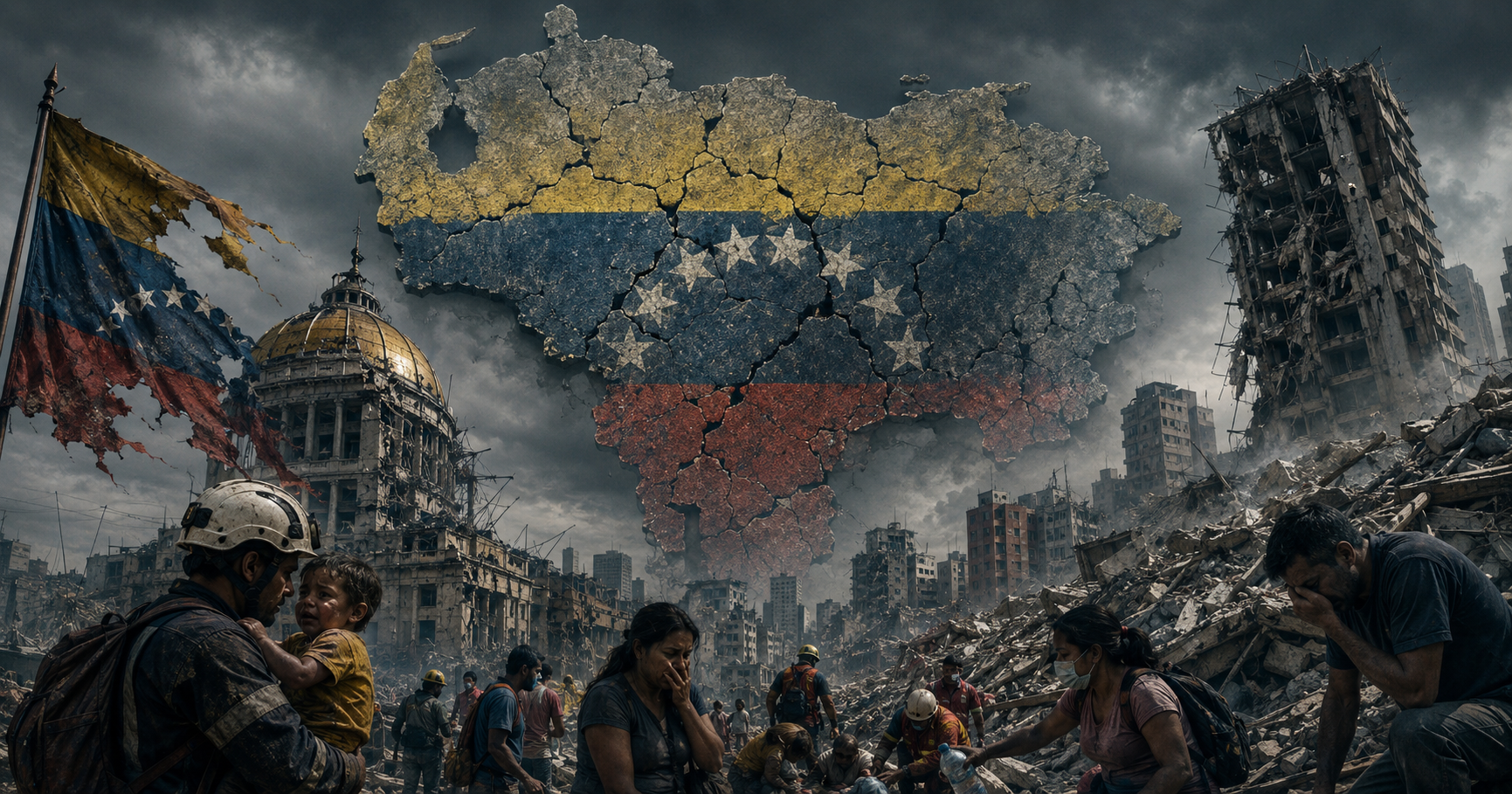
Haiti’s crisis is often described through images of gang violence, political disorder, natural disasters, poverty, and humanitarian emergency. These conditions are real, but they are not independent problems. They are interconnected consequences of a state that has progressively lost the capacity to provide security, administer justice, collect revenue, deliver public services, regulate economic activity, and maintain public confidence.
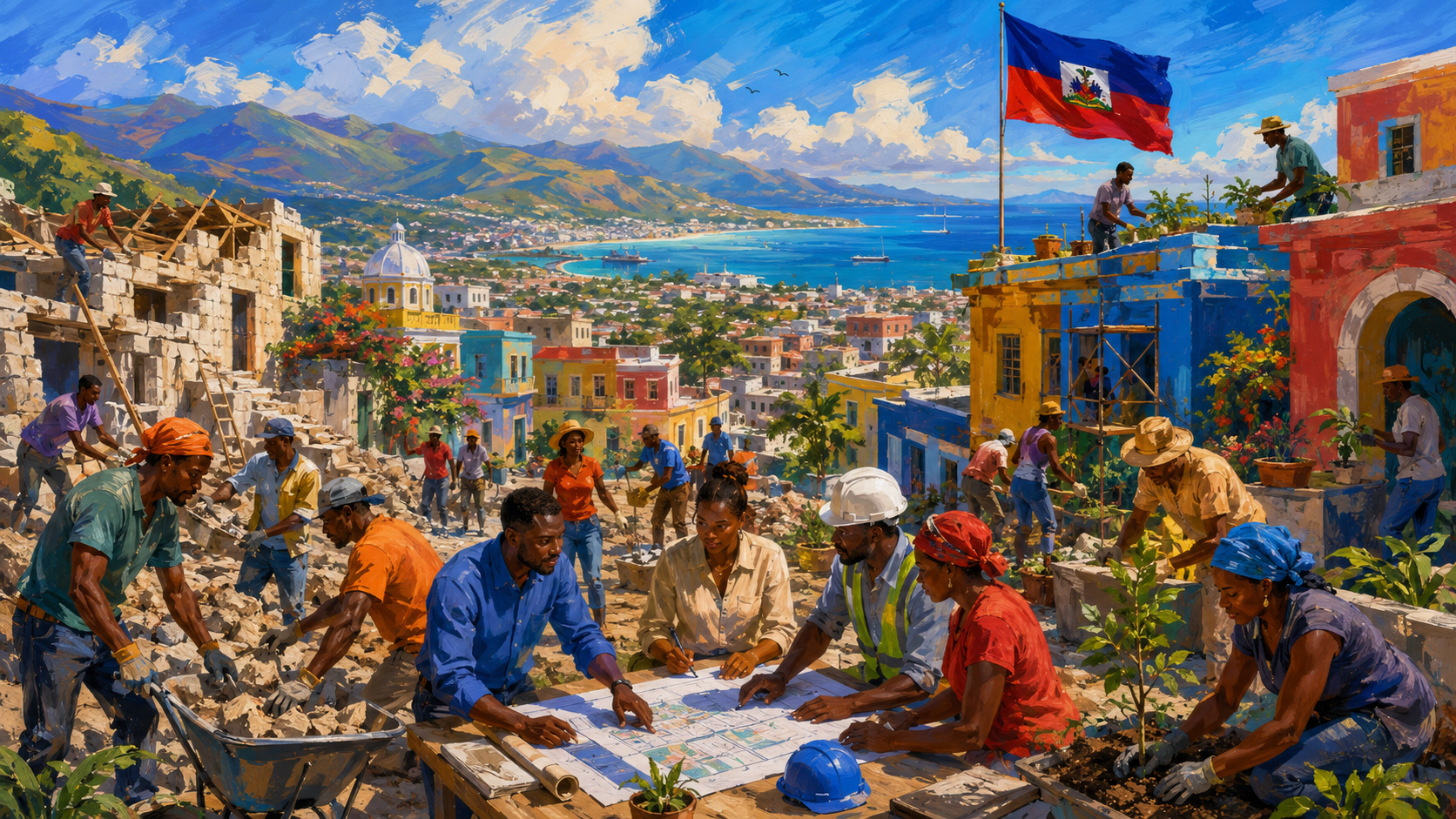
Rebuilding Haiti, therefore, cannot simply mean reconstructing roads, schools, hospitals, and government buildings. Physical reconstruction is necessary, but Haiti’s central challenge is institutional. The country must rebuild the authority, legitimacy, and capacity of the state while simultaneously restoring economic opportunity and strengthening the relationship between citizens and public institutions.
This will be extraordinarily difficult. Haiti remains trapped in a cycle in which insecurity weakens the economy, economic desperation strengthens armed groups, political instability prevents long-term planning, and institutional weakness discourages investment. The World Bank describes the country as caught in a deepening “crisis-fragility trap” shaped by political upheaval, violence, natural disasters, disease outbreaks, corruption, inequality, and weak institutions. Haiti’s economy contracted for a seventh consecutive year in 2025, while approximately 1.4 million people had been internally displaced by March 2026.
Haiti does not lack talented people, cultural strength, entrepreneurial capacity, or national identity. What it lacks is a sufficiently stable institutional framework capable of transforming those assets into sustainable development.
Why Has Haiti Been So Difficult to Rebuild?
A History of Extraction and Institutional Weakness
Any serious discussion of Haiti’s present must acknowledge the extraordinary conditions under which the country entered the international system.
Haiti emerged from the only successful large-scale slave revolution in modern history. Rather than welcoming the new republic, many international powers isolated it, fearing that the Haitian example would encourage other enslaved populations to revolt.
In 1825, France demanded an enormous indemnity from Haiti in exchange for recognizing its independence. The payment was intended to compensate former French slaveholders for their lost property, including the people they had enslaved. The original demand amounted to 150 million gold francs and forced Haiti to borrow from French financial institutions, creating what historians have called a “double debt.” In 2025, the French government formally acknowledged that the arrangement had imposed an unjust burden on Haiti, although the question of restitution remains unresolved.
This historical injustice does not explain every subsequent Haitian failure. Haitian political leaders, economic elites, foreign governments, international organizations, and private interests have all contributed to the country’s institutional deterioration at different points. Nevertheless, Haiti began its independent existence under military threat, diplomatic isolation, and severe financial extraction. Resources that might have supported education, infrastructure, agriculture, and state formation were instead directed toward debt payments and national survival.
During the following two centuries, Haiti experienced foreign interventions, authoritarian governments, coups, corruption, political exclusion, and repeated institutional breakdowns. Government frequently became an instrument for distributing patronage rather than an impartial institution serving the public.
As a result, many Haitians understandably came to view the state not as a reliable provider of justice and services, but as a distant, predatory, or partisan institution.
The Collapse of Political Legitimacy
Haiti’s political crisis is not simply the absence of an elected president or functioning parliament. It is a broader crisis of legitimacy.
Elections are indispensable, but holding elections without minimum security, credible electoral administration, functioning courts, reliable voter registration, and public confidence may reproduce instability rather than resolve it. Political competition in a weak institutional environment can become a struggle for control over state resources instead of a contest between governing programs.
The country has repeatedly relied on transitional governments, provisional agreements, foreign mediation, and temporary political arrangements. These mechanisms may prevent an immediate vacuum, but they rarely create durable legitimacy.
A sustainable political order must be based on institutions rather than personalities. Haiti requires credible electoral authorities, transparent campaign-finance rules, independent auditing, professional public administration, functioning local governments, and judicial mechanisms capable of investigating corruption and political violence.
Without those foundations, a new election may change the names of officeholders while leaving the underlying system unchanged.
Insecurity and the Privatization of Power
No national reconstruction project can advance while armed groups control neighborhoods, transportation corridors, ports, commercial zones, and access to essential services.
Gang violence has evolved beyond ordinary criminality. Armed networks have increasingly performed political, territorial, and economic functions. They tax movement, control access to communities, influence commercial activity, recruit vulnerable young people, and challenge the authority of the state.
The consequences extend far beyond direct violence. Insecurity interrupts supply chains, closes schools and businesses, damages infrastructure, increases food prices, drives professionals out of the country, and prevents public employees from reaching their workplaces. The International Monetary Fund has described Haiti’s crisis as simultaneously humanitarian, economic, social, political, and security-related, noting that violence has destroyed physical and human capital while accelerating displacement and brain drain.
Security is therefore not merely one sector of reconstruction. It is the condition that makes every other sector possible.
However, restoring security cannot be reduced to a purely military campaign. Armed intervention without courts, prisons, intelligence capacity, financial investigations, border controls, and community-based prevention will produce only temporary results.
The networks that arm and finance violent groups must also be dismantled. That requires investigating weapons trafficking, money laundering, political protection, illicit commercial relationships, customs corruption, and connections between armed organizations and powerful economic actors.
Economic Exclusion and the Informal Economy
Haiti’s economy is characterized by limited formal employment, weak domestic production, low tax collection, insufficient infrastructure, and heavy dependence on imports and remittances.
The IMF has identified the country’s low tax base, large informal sector, and dependence on volatile remittance flows as major structural vulnerabilities.
Informality is often a rational survival strategy. People operate outside the formal system because registration is costly, institutions are unreliable, credit is inaccessible, and public services are limited. But when most economic activity remains informal, the government cannot collect sufficient revenue, workers lack legal protections, businesses struggle to expand, and the state becomes even less capable of providing services.
This creates a destructive cycle: citizens avoid the formal state because it delivers little, and the state delivers little because it lacks revenue and public trust.
Haiti cannot import its way into prosperity. A reconstruction strategy must increase domestic productive capacity, particularly in agriculture, food processing, construction, textiles, logistics, renewable energy, digital services, and small-scale manufacturing.
The country possesses important advantages, including a young population, proximity to the United States and other major markets, a large diaspora, and potential in agriculture, light manufacturing, and services.
Yet these advantages will remain underused without security, electricity, transportation, access to finance, predictable regulation, and enforceable property and commercial rights.
Natural Disasters Become Institutional Disasters
Haiti is highly vulnerable to earthquakes, hurricanes, floods, landslides, erosion, and environmental degradation. But natural hazards alone do not explain the scale of destruction.
A hurricane becomes a national catastrophe when housing is poorly constructed, drainage systems are inadequate, hillsides are deforested, emergency agencies lack equipment, building codes are unenforced, and public information systems fail.
The same principle applies to earthquakes. Seismic activity cannot be prevented, but mortality and destruction can be dramatically reduced through engineering standards, land-use planning, emergency preparedness, resilient infrastructure, and professional local government.
Reconstruction must therefore be climate-resilient and disaster-conscious from the beginning. Rebuilding fragile structures in the same vulnerable locations merely prepares the country for the next disaster.
Cultural Factors: Trust, Identity, and Social Fragmentation
Culture must be discussed carefully. Haiti’s problems are not the product of some defective national character. Haitian society possesses profound resilience, creativity, religious traditions, artistic achievement, family solidarity, and a powerful historical identity.
The difficulty lies not in Haitian culture itself, but in the way generations of insecurity and institutional failure have shaped political and social behavior.
When institutions cannot be trusted, people depend on family networks, local communities, churches, informal associations, neighborhood leaders, and personal relationships. These networks are essential for survival, but they can also reinforce fragmentation when they become substitutes for national institutions.
Political loyalty may become personal rather than programmatic. Access to employment or services may depend on connections rather than transparent rules. Citizens may distrust government promises because previous reforms produced few visible improvements.
There is also a long-standing divide between the formal institutions of the state and the lived reality of much of the population. Language illustrates part of this distance. Haitian Creole is spoken throughout the country, while French has historically carried greater authority in administration, law, education, and elite society. A state that communicates above or beyond much of its population will struggle to build full democratic participation.
Reconstruction must therefore be conducted in the language, institutions, and social structures that Haitian citizens actually use. Public information, legal documents, education, government services, and democratic participation should be genuinely accessible in Haitian Creole as well as French.
Local civil-society and humanitarian organizations have repeatedly demonstrated their ability to support communities under extreme conditions. International officials have also recognized that Haitians frequently seek not permanent dependency but the means to support themselves and rebuild their own communities.
This capacity should be treated as the foundation of reconstruction—not as an afterthought.
What Should Be Done?
Establish Security Through a Haitian Institutional Framework
The immediate priority must be the restoration of basic security in strategic areas, including ports, airports, fuel terminals, hospitals, schools, commercial corridors, government facilities, and major transportation routes.
International security assistance may be necessary, but it must operate within a clearly defined political and institutional strategy. Its objective should not be indefinite foreign control. It should be the creation of conditions under which professional Haitian institutions can function.
Security reform should include:
- Vetting, training, equipping, and properly paying the Haitian National Police.
- Developing specialized units for kidnapping, financial crime, weapons trafficking, and organized crime.
- Protecting judges, prosecutors, witnesses, journalists, and anti-corruption investigators.
- Rehabilitating courts, prisons, and forensic capacity.
- Establishing transparent oversight to prevent abuse and political manipulation.
- Tracing the financial and political networks that support armed groups.
- Strengthening customs, port security, and border management.
Security operations must be accompanied by protection for civilians and credible human-rights monitoring. Otherwise, communities may simply experience a change in the source of coercion.
Build a Limited but Functional Transitional State
Haiti should not attempt to reform every institution simultaneously. The initial objective should be a limited state capable of performing several essential functions reliably.
Those functions should include public security, justice, revenue collection, basic health, primary education, infrastructure maintenance, civil registration, electoral administration, and disaster response.
Progress should be measured through concrete public benchmarks. How many courts are operating? How many schools have reopened? How much customs revenue is being collected? How quickly are public employees being paid? How many municipalities can provide basic services?
A government that performs a smaller number of functions competently will build more legitimacy than one that announces ambitious national plans but delivers little.
Create a Credible Roadmap to Elections
Elections should be treated as part of institutional reconstruction, not as a symbolic deadline imposed from abroad.
Before nationwide elections can be credible, Haiti requires secure polling locations, an updated voter registry, trained electoral personnel, transparent procurement, dispute-resolution mechanisms, and public observation.
Local and municipal elections should receive far more attention. Democratic legitimacy cannot be built exclusively in Port-au-Prince. Municipal governments must become meaningful institutions with clearly defined budgets, responsibilities, and mechanisms of public accountability.
The political transition should also include structured participation from civil society, business associations, universities, professional organizations, women’s groups, youth representatives, religious institutions, rural communities, and the diaspora.
Declare a National Campaign Against Corruption and Impunity
Anti-corruption reform cannot consist of speeches, new commissions, or selective prosecutions against political opponents.
Haiti needs transparent government procurement, published budgets, asset declarations for senior officials, independent audits, digital customs systems, public tracking of reconstruction contracts, and protections for whistleblowers and investigative journalists.
International donors must apply the same transparency standards to themselves. Every major reconstruction project should publicly identify its funding source, contractor, local partners, cost, deadlines, and measurable results.
The history of failed or poorly coordinated assistance has understandably generated suspicion. Transparency must apply to Haitian institutions, foreign governments, nongovernmental organizations, international contractors, and multilateral agencies alike.
Rebuild the Economy From the Local Level
Economic recovery should begin with the sectors most capable of creating employment quickly and reducing dependence on imports.
Agriculture must be central. Haiti needs investment in irrigation, rural roads, storage facilities, agricultural credit, seeds, veterinary services, cooperatives, watershed restoration, and local food-processing capacity.
Public procurement can support this transformation. Schools, hospitals, police facilities, and government offices should purchase Haitian agricultural products and locally manufactured goods whenever feasible.
Small and medium-sized businesses need simplified registration, access to microcredit and commercial financing, reliable electricity, digital payment systems, and protection from extortion.
Special economic zones or foreign investment projects may contribute to employment, but they should not become isolated enclaves disconnected from Haitian suppliers, workers, and communities. Investment incentives should be tied to training, local purchasing, labor protections, and infrastructure development.
Mobilize the Haitian Diaspora Beyond Remittances
The Haitian diaspora is one of the country’s greatest strategic resources.
Diaspora communities already support families through remittances, but their contribution could extend much further. Haiti should create secure mechanisms for diaspora investment, professional exchanges, municipal partnerships, technical assistance, scholarships, and temporary public service.
Diaspora bonds or investment funds could finance specific, independently audited infrastructure projects. Haitian doctors, engineers, educators, entrepreneurs, attorneys, and technology professionals living abroad could participate in structured programs without permanently relocating.
For this to succeed, the government must provide legal protection, transparent accounting, and credible guarantees that funds will not disappear into patronage networks.
Make Education a National Security Priority
Haiti’s long-term stability depends on whether young people see a future outside armed groups, migration, and informal survival.
Education policy should prioritize reopening schools, protecting students and teachers, expanding vocational training, improving teacher preparation, and connecting curricula to realistic employment opportunities.
Vocational programs should focus on construction, electrical work, plumbing, mechanics, agriculture, nursing, information technology, logistics, renewable energy, and disaster-resistant engineering.
Education should also strengthen civic understanding. Students should learn how public institutions are supposed to function, how citizens can demand accountability, and why political disagreement must be resolved through law rather than violence.
Reconstruct Outside Port-au-Prince
Haiti’s extreme concentration of population, administration, commerce, and political power in Port-au-Prince has created national vulnerability.
Reconstruction must promote regional development through secondary cities and rural municipalities. Government agencies, universities, hospitals, industries, and infrastructure investments should be distributed more evenly across the country.
Decentralization should not simply transfer responsibilities to municipalities without resources. Local governments need predictable revenue, trained administrators, technical support, public auditing, and meaningful authority.
A more geographically balanced Haiti would reduce pressure on the capital while creating economic opportunities closer to where people live.
Build Disaster-Resilient Infrastructure
Every new road, school, hospital, public building, housing project, communications network, and energy facility should be designed for the environmental risks Haiti faces.
Construction standards must be enforceable, not merely written. Engineers and inspectors must be professionally trained and protected from political interference.
Reforestation, watershed protection, drainage, coastal management, and sustainable agriculture should be treated as essential infrastructure investments. Environmental recovery is directly connected to food security, public health, disaster prevention, and economic development.
Replace the International Aid Model With a Haitian-Led Compact
International assistance has frequently been fragmented among donors, contractors, agencies, and nongovernmental organizations. Projects may achieve short-term humanitarian objectives while bypassing or further weakening national institutions.
Future cooperation should operate through a Haitian-led national recovery compact with clear priorities, transparent funding, public benchmarks, and independent monitoring.
This does not mean transferring money blindly to weak or corrupt institutions. It means designing aid so that every project builds Haitian administrative, technical, and professional capacity.
Foreign contractors should be required to train Haitian workers and institutions. Parallel systems should be temporary. Programs should include plans for local ownership, maintenance, and financial sustainability from the beginning.
The World Bank’s 2025–2029 framework similarly identifies restoring governance, maintaining essential services, protecting institutional capacity, and resuming growth as central priorities for Haiti’s recovery.
A Sequenced Strategy for Reconstruction
Haiti cannot accomplish all of these objectives at once. Recovery must be sequenced.
The first phase should focus on humanitarian access, strategic security, reopening transportation corridors, protecting essential infrastructure, restoring basic government operations, and preventing further institutional collapse.
The second phase should emphasize courts, policing, public finance, schools, health services, municipal administration, anti-corruption safeguards, and preparation for credible elections.
The third phase should concentrate on long-term economic transformation, regional development, infrastructure, agricultural productivity, energy, education, environmental protection, and integration into Caribbean and global markets.
These phases will overlap. Nevertheless, sequencing matters. Large development projects cannot succeed where contractors are kidnapped, roads are controlled by armed groups, courts do not function, and public agencies cannot administer funds.
Haiti Must Be Rebuilt With Haitians, Not Merely for Them
The international community has often approached Haiti as an emergency to be managed rather than a nation to be strengthened.
This approach has produced cycles of intervention, stabilization, humanitarian relief, donor fatigue, withdrawal, and renewed crisis. Each cycle addresses urgent symptoms but leaves the underlying institutional weakness substantially unchanged.
Haiti requires international solidarity, but solidarity must be different from dependency. Foreign assistance should reinforce Haitian authority where it is legitimate, Haitian civil society where it is effective, Haitian businesses where they can create employment, and Haitian communities where they are already solving problems.
The cultural foundations for recovery already exist: strong family networks, community solidarity, religious and civic organizations, entrepreneurial energy, artistic creativity, historical consciousness, and an extensive diaspora.
The task is to connect those social resources to institutions that are lawful, accountable, inclusive, and capable.
Haiti is not impossible to rebuild. But it cannot be rebuilt through improvised political transitions, isolated infrastructure projects, externally designed aid programs, or short-term security deployments.
Its reconstruction requires a national project that integrates security, justice, democratic legitimacy, economic production, education, decentralization, environmental resilience, and cultural inclusion.
The first measure of success will not be a dramatic announcement or international conference. It will be whether ordinary Haitians can travel safely, send their children to school, operate a business without extortion, receive justice from a functioning court, access basic public services, and believe that government institutions belong to them.
Rebuilding Haiti means rebuilding the relationship between the citizen and the state.
Until that relationship is restored, physical reconstruction will remain vulnerable to the next political crisis, armed confrontation, economic shock, or natural disaster. Once it is restored, Haiti’s people will have the institutional foundation needed to rebuild the country themselves.
AFDES publishes independent research and strategic analysis on democracy, governance, public policy, international affairs, and civic institutions.