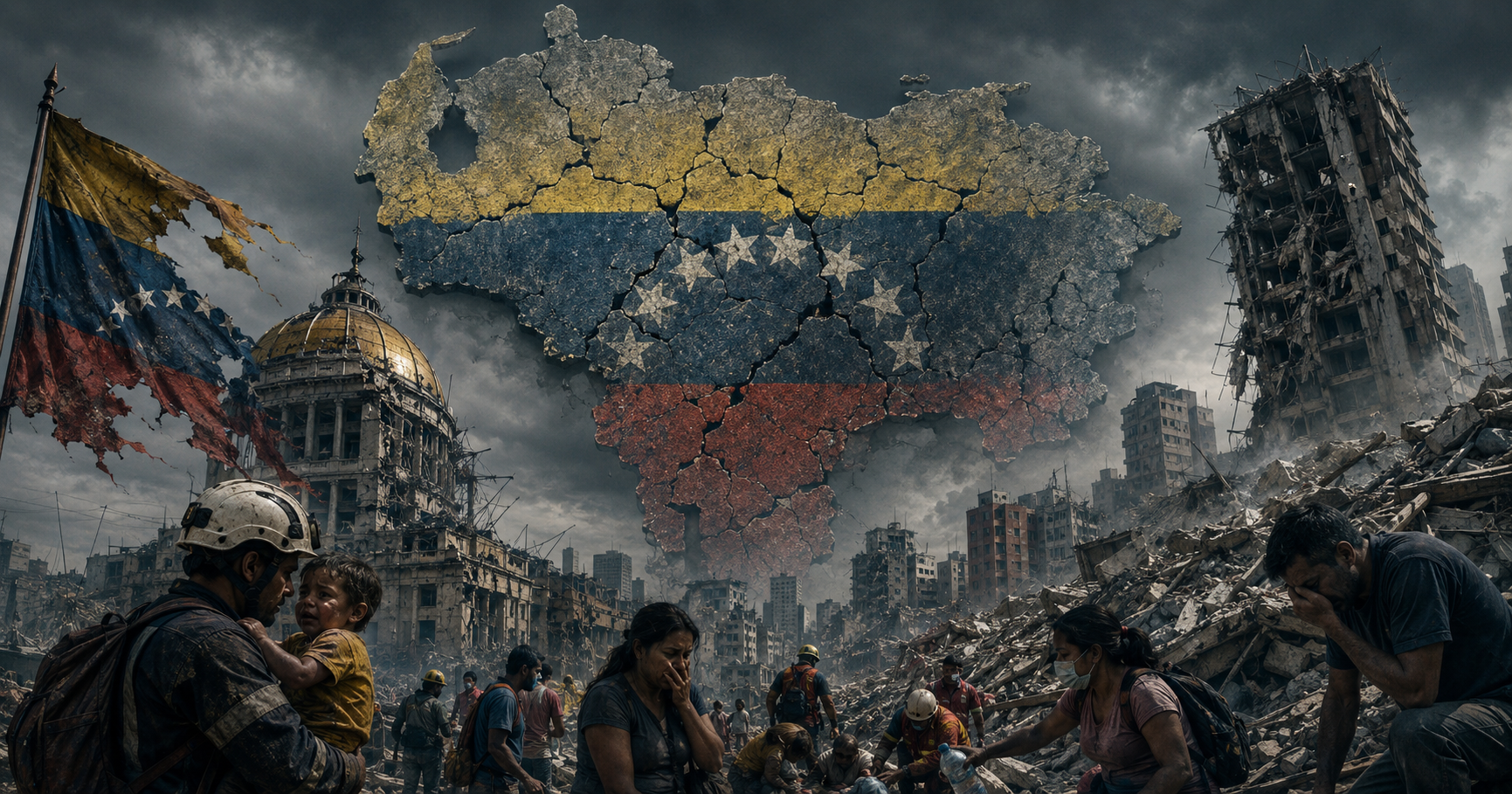
The earthquake that struck Venezuela is more than a natural disaster. It is a political X-ray of a country weakened by nearly three decades of ideological control, institutional decay, corruption, and administrative incompetence. Buildings collapse during earthquakes, but states collapse long before the ground begins to move. In Venezuela, the tragedy has exposed what millions of citizens have known for years: the Chavista model did not only impoverish the economy; it hollowed out the state’s capacity to protect its people.
For 27 years, Venezuela has lived under the long shadow of Chavismo, a political project that promised dignity, sovereignty, social justice, and national independence. In practice, it produced a centralized authoritarian system where loyalty mattered more than competence, propaganda replaced public policy, and institutions were transformed into instruments of political control. The earthquake now challenges that legacy in the most painful way possible: by measuring the state not through speeches, slogans, or revolutionary symbolism, but through rescue operations, hospitals, logistics, infrastructure, emergency management, and the capacity to save lives.
Natural disasters do not create institutional failure. They reveal it.
A disaster meets a failed state
The first obligation of any government during a catastrophe is simple: respond quickly, coordinate effectively, communicate honestly, and mobilize every available resource to protect the population. In Venezuela, that task is complicated by years of economic collapse, professional migration, decayed infrastructure, politicized institutions, and corruption in public administration.
A serious emergency response requires trained firefighters, engineers, medical personnel, civil protection agencies, reliable transportation, functioning hospitals, communications systems, fuel supply, heavy equipment, transparent command structures, and trust between the state and society. Venezuela enters this disaster with all of those systems weakened.
The earthquake did not strike a normal country. It struck a country where hospitals have struggled for years with shortages, where public services have been unreliable, where millions of professionals have emigrated, where infrastructure maintenance has been neglected, and where the public sector has been shaped by political loyalty rather than technical capacity.
This is the central political meaning of the earthquake: the Chavista state spent years building mechanisms of control, but failed to preserve the basic mechanisms of public protection.
A government can survive protests with repression. It can survive elections with manipulation. It can survive economic failure with propaganda. But a major disaster is different. A disaster forces the state to perform in real time. It demands competence. It exposes lies. It shows citizens, neighborhood by neighborhood, whether the system exists to serve them or to preserve itself.
Twenty-seven years of Chavista inefficiency
Chavismo has always presented itself as a movement of popular power. It claimed to govern for the poor, the excluded, the barrios, the workers, and the forgotten. Yet the earthquake shows the contradiction at the heart of that claim. The communities most vulnerable to disaster are often the same communities most harmed by decades of state failure.
Poor urban planning, neglected infrastructure, informal construction, lack of inspection, weak emergency preparedness, and underfunded civil defense systems are not accidents. They are the consequences of governance choices.
For years, oil wealth was used to build political dependency rather than national resilience. Public spending was directed toward ideological projects, patronage networks, military loyalty, propaganda, and foreign political influence. Meanwhile, hospitals deteriorated, infrastructure aged, public utilities declined, and technical institutions lost capacity.
The tragedy is not simply that Venezuela suffered an earthquake. The tragedy is that a country with enormous natural wealth was left so vulnerable after almost three decades of revolutionary government.
The Chavista leadership often blamed external enemies, sanctions, imperialism, business elites, and political opponents for Venezuela’s failures. But earthquakes do not obey propaganda. Rubble cannot be explained away by ideology. A collapsed building does not care about slogans. A hospital without supplies cannot be repaired with speeches. A family waiting for rescue cannot be comforted by revolutionary mythology.
The earthquake forces a brutal question: after 27 years in power, what did Chavismo build that could protect the Venezuelan people?
Corruption as a national security threat
Corruption is often discussed as a financial crime, but in Venezuela it has become something deeper: a national security threat and a humanitarian risk. When public money disappears, bridges are not maintained, hospitals are not supplied, emergency agencies are not equipped, and construction standards are not enforced. Corruption kills slowly before it kills suddenly.
In a disaster, every stolen dollar becomes visible. It appears in the absence of rescue equipment, the shortage of ambulances, the lack of medicine, the collapse of public services, and the inability of authorities to coordinate relief.
Venezuela’s long crisis cannot be separated from the corruption that became embedded in the Chavista system. The politicization of the oil industry, opaque public contracts, military control over key economic sectors, and the enrichment of politically connected elites created a state where power was profitable and accountability was nearly impossible.
This matters because disaster response depends on trust. Citizens must believe that aid will reach victims, that official information is reliable, that rescue priorities are based on need rather than politics, and that reconstruction funds will not be captured by the same networks that helped produce the crisis.
In Venezuela, that trust has been destroyed. The earthquake therefore becomes not only a humanitarian emergency but also a legitimacy crisis.
Maduro’s removal and the collapse of the Chavista myth
The political shock is even greater because the disaster comes after the extraordinary fall of Nicolás Maduro, who has been taken into U.S. custody and charged in connection with drug-trafficking and narcoterrorism allegations. He remains legally presumed innocent, but the charges represent a historic humiliation for the Chavista project.
For years, Maduro presented himself as the defender of Venezuelan sovereignty against foreign aggression. Now, his image is no longer that of an untouchable revolutionary leader standing on a balcony in Caracas, but of a former ruler facing criminal proceedings in the United States.
This changes the psychology of power in Venezuela.
Chavismo depended heavily on symbols: the military uniform, the revolutionary anthem, the image of Hugo Chávez, the anti-imperialist speech, the promise of permanent resistance. Maduro’s removal weakens that symbolic architecture. It tells officials, military officers, party loyalists, and ordinary citizens that the system is not invincible.
The earthquake intensifies that perception. It arrives at a moment when Chavismo is already politically wounded, legally exposed, and morally exhausted. The regime’s old narrative — that it alone represents the people — becomes harder to sustain when citizens are digging through rubble, waiting for medicine, searching for relatives, and depending on foreign assistance to survive.
A system that claimed to be sovereign now appears dependent. A system that claimed to be powerful now appears fragile. A system that claimed to protect the poor now appears unable to protect anyone.
The regional context: Latin America moves on
Venezuela’s crisis also unfolds in a changing regional environment. The era in which Chavismo could count on broad ideological sympathy across Latin America is weaker than before. The left-wing wave that once elevated Chávez as a continental figure has lost much of its energy. Across the region, voters are increasingly punishing governments associated with insecurity, inflation, migration pressure, corruption, and economic stagnation.
This does not mean Latin America has permanently moved to the right. The region is politically volatile, and voters often shift against incumbents rather than toward a fixed ideology. But the broader trend is clear: the romanticism that once surrounded revolutionary left-wing projects has faded. Citizens are demanding order, jobs, security, functioning services, and competent government.
For Venezuela, this matters enormously.
Chavismo once projected influence beyond its borders. It funded allies, built ideological networks, promoted regional organizations, and presented itself as a model of anti-U.S. resistance. Today, Venezuela is no longer exporting revolution. It is exporting migrants, instability, humanitarian needs, and cautionary lessons.
The earthquake reinforces that regional lesson. It shows what happens when ideology consumes institutions, when corruption replaces governance, and when political survival becomes more important than state capacity.
Neighboring governments may offer condolences and aid, but few can still pretend that the Chavista model represents a successful alternative for Latin America. Venezuela is not a model to imitate. It is a warning.
Economic collapse deepens the humanitarian emergency
The earthquake also lands on top of a deep economic and social crisis. Venezuela’s economy has already suffered years of contraction, inflation, sanctions, mismanagement, and institutional breakdown. Millions of Venezuelans have left the country, including doctors, engineers, construction professionals, academics, entrepreneurs, and public-sector specialists whose knowledge would be essential in a disaster.
This human capital loss is one of the most damaging consequences of Chavismo. A country can rebuild roads and buildings faster than it can rebuild a professional class. When engineers leave, infrastructure suffers. When doctors leave, hospitals weaken. When teachers leave, future capacity declines. When entrepreneurs leave, recovery becomes harder.
Disasters require not only money but expertise. Venezuela has lost much of both.
The economic crisis also limits household resilience. Families that already struggled to buy food, medicine, fuel, or basic supplies are less able to absorb the shock of displacement, injury, loss of housing, or unemployment. A natural disaster in a stable economy is devastating. A natural disaster in a collapsed economy is catastrophic.
The earthquake therefore becomes a multiplier of existing suffering. It deepens poverty, accelerates displacement, increases public health risks, and places additional pressure on a society already exhausted by years of crisis.
A test for the transition
If Venezuela is entering a new political phase after Maduro’s fall, the earthquake may become the first great test of that transition. Emergency management will reveal whether the country can move from authoritarian control toward institutional recovery.
The immediate priority must be humanitarian: rescue survivors, treat the injured, restore basic services, secure shelter, distribute food and water, and coordinate international aid transparently. But the medium-term challenge is political: rebuild trust, professionalize institutions, audit infrastructure, protect reconstruction funds, and prevent aid from becoming another instrument of patronage.
A serious reconstruction plan must avoid the old Chavista pattern of using crisis to centralize power. Venezuela does not need revolutionary theater. It needs engineers, doctors, local governments, civil society, churches, international partners, private companies, universities, and transparent public administration.
The country also needs truth. Citizens deserve accurate casualty figures, honest assessments of damage, open accounting of foreign aid, and public investigations into construction failures and emergency-response weaknesses.
Without transparency, reconstruction will reproduce the same corruption that helped make the disaster worse.
The moral failure of Chavismo
The deepest failure of Chavismo is not only economic or institutional. It is moral. A movement that claimed to defend human dignity left millions of Venezuelans vulnerable, poor, displaced, censored, and dependent on a state that could not function when they needed it most.
The earthquake exposes that moral failure. It shows the difference between political performance and public service. For years, the regime mastered the language of solidarity while destroying the conditions that make solidarity effective: trust, competence, institutions, infrastructure, and freedom.
The Venezuelan people have endured political repression, economic collapse, mass migration, criminal networks, corruption, and now a devastating natural disaster. Yet the response from ordinary citizens — neighbors helping neighbors, volunteers searching through rubble, families sharing supplies, doctors and rescuers working under impossible conditions — reveals something the regime never destroyed: the civic strength of Venezuelan society.
That civic strength may become the foundation of national reconstruction.
The ground moved, but the system was already broken
The earthquake did not break Venezuela. Chavismo had been breaking Venezuela for 27 years. The disaster merely exposed the scale of the damage.
It revealed a state weakened by corruption, a public sector drained by inefficiency, an economy exhausted by mismanagement, and a political model that confused control with governance. It arrived at a historic moment, with Maduro facing criminal charges in the United States and the region increasingly skeptical of the ideological promises that once gave Chavismo influence.
Venezuela now faces two emergencies at once: the physical emergency of rescue and reconstruction, and the political emergency of rebuilding a state capable of serving its citizens.
The first requires food, medicine, shelter, engineers, doctors, rescue teams, and international assistance. The second requires accountability, institutional reform, democratic legitimacy, and the end of the corrupt political culture that turned a wealthy country into a fragile one.
The earthquake is a national tragedy. But it is also a national reckoning.
For Venezuela, the question is no longer whether Chavismo failed. The rubble has answered that. The question now is whether Venezuelans, with the support of democratic partners and honest institutions, can build something better from the ruins.
AFDES publishes independent research and strategic analysis on democracy, governance, public policy, international affairs, and civic institutions.