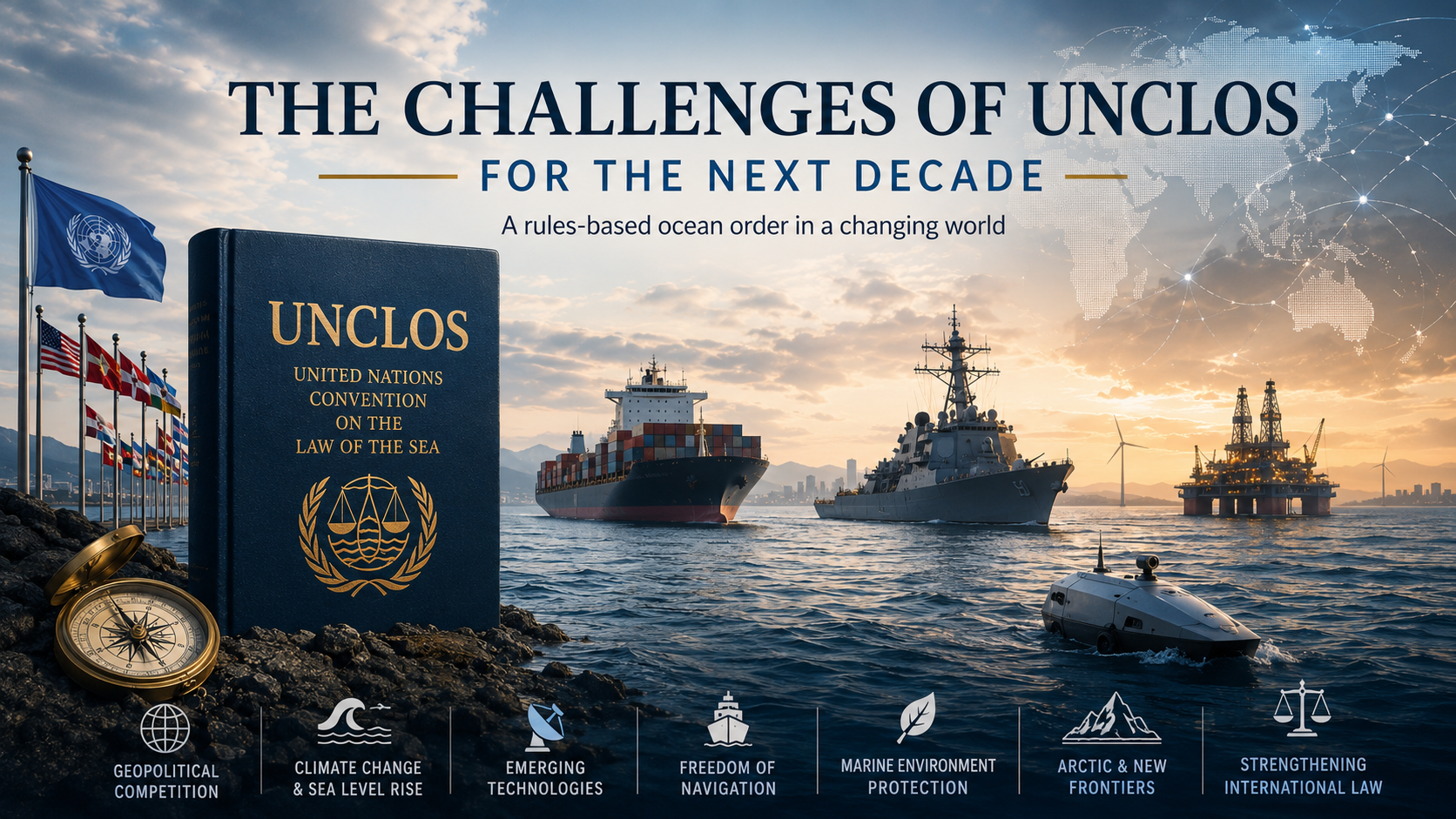
For more than four decades, the United Nations Convention on the Law of the Sea (UNCLOS) has served as the cornerstone of modern maritime governance. Often described as the "Constitution for the Oceans," the Convention establishes the legal framework governing territorial waters, exclusive economic zones (EEZs), continental shelves, freedom of navigation, environmental protection, and the exploitation of marine resources. Since its adoption in 1982 and entry into force in 1994, UNCLOS has contributed significantly to reducing maritime disputes by providing internationally recognized legal principles applicable to nearly every coastal state.
Despite its enduring importance, the international environment in which UNCLOS operates has changed dramatically. Intensifying geopolitical competition, rapid technological innovation, climate change, and the growing strategic value of maritime resources have introduced challenges that the Convention's original drafters could not fully anticipate. The next decade will test not only the relevance of UNCLOS but also the willingness of states to continue respecting a rules-based maritime order amid increasing great-power rivalry.
Great Power Competition
One of the most significant challenges confronting UNCLOS is the return of geopolitical competition among major powers. Maritime disputes are increasingly driven by strategic and military considerations rather than purely legal disagreements.
The South China Sea illustrates this trend. Competing territorial claims involving China, Vietnam, the Philippines, Malaysia, Brunei, and Taiwan have transformed one of the world's busiest maritime regions into a strategic flashpoint. Although the Permanent Court of Arbitration ruled in 2016 that China's expansive "Nine-Dash Line" claims lacked legal basis under UNCLOS, Beijing rejected the decision and has continued expanding its military and civilian presence across disputed features.
This case demonstrates one of UNCLOS's principal limitations: while the Convention establishes legal rights and obligations, it lacks independent enforcement mechanisms. Compliance ultimately depends upon the political willingness of states rather than compulsory international authority.
As strategic competition between the United States and China intensifies, legal interpretations of maritime rights increasingly intersect with military deterrence, alliance politics, and regional security concerns.
Climate Change and Maritime Boundaries
Climate change represents another unprecedented challenge for the Law of the Sea.
Rising sea levels threaten to alter coastlines, submerge islands, and affect the baselines from which maritime zones are measured. For small island developing states in the Pacific and Indian Oceans, this issue is existential.
If an island disappears beneath rising seas, questions arise regarding the continued validity of its territorial sea, contiguous zone, exclusive economic zone, and continental shelf rights.
UNCLOS was negotiated before climate-induced sea level rise became a central concern of international law. Consequently, the Convention provides limited guidance on whether maritime boundaries should remain fixed or move with changing coastlines.
The absence of clear legal standards could generate numerous disputes during the coming decade, particularly among states whose economies depend heavily on fisheries, offshore energy production, and maritime commerce.
International legal scholars increasingly advocate preserving existing maritime boundaries regardless of physical coastline changes to maintain stability and prevent future conflict.
Emerging Technologies
Technological advances are reshaping maritime activity at a pace far exceeding legal adaptation.
Autonomous vessels, artificial intelligence, satellite surveillance, underwater drones, and unmanned maritime systems are transforming both commercial shipping and naval operations.
UNCLOS was drafted during an era in which ships were operated exclusively by human crews. Questions surrounding liability, navigation standards, collision responsibility, and autonomous military systems remain only partially addressed by existing international law.
Similarly, deep-sea mining has emerged as a major area of concern.
Advances in extraction technology have increased interest in harvesting polymetallic nodules and rare earth minerals located on the ocean floor beyond national jurisdiction. These resources are increasingly viewed as strategically important for batteries, renewable energy technologies, and advanced manufacturing.
Balancing economic development with environmental protection will become one of the International Seabed Authority's most difficult responsibilities over the next decade.
Freedom of Navigation
Freedom of navigation remains one of UNCLOS's most important principles, yet it has become increasingly contested.
Several coastal states interpret innocent passage and military navigation differently, particularly regarding foreign naval vessels operating within Exclusive Economic Zones.
The United States conducts Freedom of Navigation Operations (FONOPs) worldwide to challenge what it considers excessive maritime claims. Other states argue that military intelligence gathering and surveillance activities within EEZs violate national security interests even if they remain outside territorial waters.
This divergence in legal interpretation increases the risk of dangerous encounters between military forces at sea.
As naval modernization accelerates across Asia, Europe, and the Indo-Pacific, maintaining predictable legal standards for military navigation will become increasingly important for international stability.
Marine Environmental Protection
UNCLOS places significant emphasis on protecting the marine environment.
However, ocean pollution has expanded dramatically since the Convention entered into force.
Plastic pollution, chemical contamination, overfishing, habitat destruction, and biodiversity loss have become global environmental challenges requiring coordinated international responses.
Climate change further compounds these problems by contributing to coral bleaching, ocean acidification, and shifting fish populations.
Although UNCLOS establishes general obligations regarding environmental protection, implementation largely depends upon national legislation and international cooperation.
Strengthening compliance mechanisms without undermining state sovereignty will remain a difficult political balancing act.
The Arctic
Perhaps no region better illustrates the future challenges facing UNCLOS than the Arctic.
Melting sea ice is opening new shipping routes while simultaneously increasing access to vast deposits of hydrocarbons and critical minerals.
Russia, Canada, Denmark (through Greenland), Norway, and the United States possess significant strategic interests in the region.
As commercial navigation expands and military activity increases, competing continental shelf claims submitted under Article 76 of UNCLOS are likely to receive greater international attention.
The Arctic demonstrates how environmental change, economic opportunity, and geopolitical rivalry are becoming increasingly interconnected within the law of the sea.
Conclusion
UNCLOS remains one of the most successful multilateral legal instruments ever negotiated. It has established a comprehensive framework governing maritime rights and responsibilities while contributing significantly to international stability.
Nevertheless, the coming decade will challenge the Convention in ways that its architects could scarcely have anticipated.
Great-power competition, climate change, emerging technologies, environmental degradation, and expanding competition over maritime resources will require both political restraint and continued legal innovation.
The Convention itself is unlikely to become obsolete. Rather, its effectiveness will depend upon the willingness of states to reaffirm their commitment to international law despite increasing geopolitical tensions.
Ultimately, the future of UNCLOS will not be determined solely by legal interpretation but by whether the international community continues to view a rules-based maritime order as preferable to one governed primarily by power and coercion. As strategic competition increasingly shifts toward the world's oceans, preserving the legitimacy and effectiveness of UNCLOS will remain essential for maintaining international peace, maritime security, and the sustainable use of one of humanity's most important global commons.
AFDES publishes independent research and strategic analysis on democracy, governance, public policy, international affairs, and civic institutions.