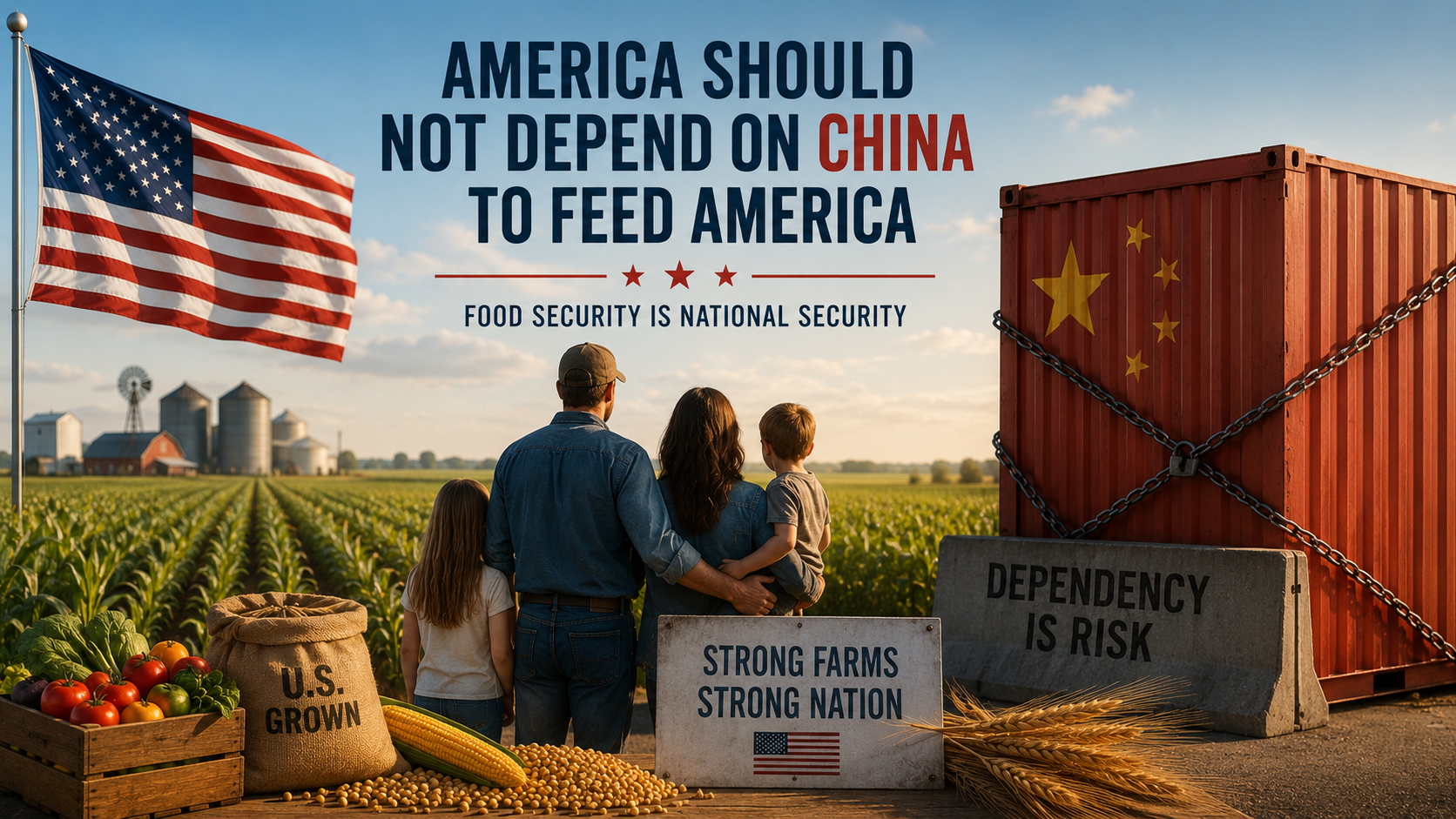
Food security is national security.
For decades, the United States has maintained one of the most productive agricultural sectors in the world. American farmers produce enormous quantities of corn, soybeans, wheat, beef, poultry, dairy products, fruits, and vegetables that feed not only the domestic population but also millions of people overseas. Yet despite this agricultural strength, an increasing number of policymakers are warning that the United States has become dangerously dependent on foreign supply chains—including China—for key components of its food system.
This concern extends well beyond imported food products. It includes fertilizers, agricultural chemicals, food processing equipment, pharmaceutical ingredients used in livestock production, rare earth minerals required for modern farming technology, and ownership of agricultural infrastructure. Members of Congress from both political parties have increasingly argued that America's food supply should never become vulnerable to geopolitical competitors.
Recent congressional discussions have focused on reducing strategic dependence on China in critical sectors, including agriculture, food processing, and farmland ownership. Lawmakers have proposed measures aimed at restricting purchases of American farmland by entities linked to foreign adversaries, strengthening domestic agricultural production, and securing critical supply chains. These debates reflect a growing bipartisan consensus that food production cannot be viewed solely through the lens of economics but must also be considered a matter of national security.
The lesson is straightforward: a nation that cannot reliably feed itself risks losing strategic independence during times of crisis.
History provides countless examples. Throughout the twentieth century, blockades, sanctions, wars, and political instability repeatedly demonstrated that food can become an instrument of geopolitical pressure. While the United States currently remains one of the world's largest agricultural producers, increasing reliance on global supply chains has created vulnerabilities that could become significant during a major international confrontation.
China itself offers an important contrast. Despite possessing limited arable land relative to its population, Beijing has spent decades pursuing policies designed to strengthen domestic food security. Chinese leaders have consistently emphasized agricultural modernization, strategic grain reserves, overseas investment in food production, and diversification of import sources as national priorities. Food security has long been viewed in Beijing as an essential component of state security.
The United States should adopt a similarly strategic perspective—without abandoning the benefits of international trade.
One concern frequently raised by policymakers involves ownership of agricultural land. Several states have enacted or considered laws limiting purchases of farmland by foreign entities associated with geopolitical rivals. Supporters argue that farmland is not merely another investment asset but a strategic national resource comparable to ports, energy infrastructure, or telecommunications networks. Critics respond that restrictions should be carefully tailored to avoid discouraging legitimate foreign investment while respecting property rights.
Another challenge involves supply-chain resilience. Modern agriculture depends upon sophisticated logistics networks that span multiple continents. Fertilizers, crop protection chemicals, machinery components, electronic sensors, and precision farming technologies often originate from numerous international suppliers. Disruptions caused by pandemics, natural disasters, trade disputes, or military conflict can quickly expose weaknesses within those supply chains.
The COVID-19 pandemic illustrated how rapidly shortages can emerge when global transportation systems become strained. Similar disruptions affecting agricultural inputs could significantly reduce productivity if alternative domestic sources are unavailable.
There is also a technological dimension to food security. Precision agriculture increasingly relies upon satellites, artificial intelligence, autonomous equipment, and advanced sensors. These technologies improve efficiency while simultaneously increasing dependence upon secure digital infrastructure. Protecting agricultural technology from cyber threats has therefore become an emerging national security priority.
None of this suggests that the United States should isolate itself from global trade. International commerce remains essential for economic growth, competitive markets, and consumer choice. Rather, the objective should be strategic resilience.
Diversification—not isolation—offers the most sustainable path forward.
Critical agricultural inputs should come from multiple reliable partners rather than concentrating production within geopolitical competitors. Domestic manufacturing of fertilizers, food-processing equipment, and agricultural technologies should be encouraged where economically feasible. Investments in agricultural research, rural infrastructure, water management, and workforce development can further strengthen America's long-term food resilience.
Ultimately, the debate extends beyond economics.
A nation capable of producing its own food possesses strategic flexibility that cannot easily be measured in dollars. During international crises, wars, pandemics, or natural disasters, domestic food production becomes one of the most important pillars of national stability.
The United States has the land, the technology, the scientific expertise, and the farmers necessary to remain one of the world's great agricultural powers. The challenge for policymakers is ensuring that future decisions strengthen—not weaken—that advantage.
Food security should never become an afterthought in national security planning. In an increasingly uncertain geopolitical environment, America's ability to feed its own people remains one of its greatest strategic assets, and preserving that capability should be viewed as a long-term national priority rather than a temporary political issue.
AFDES publishes independent research and strategic analysis on democracy, governance, public policy, international affairs, and civic institutions.